


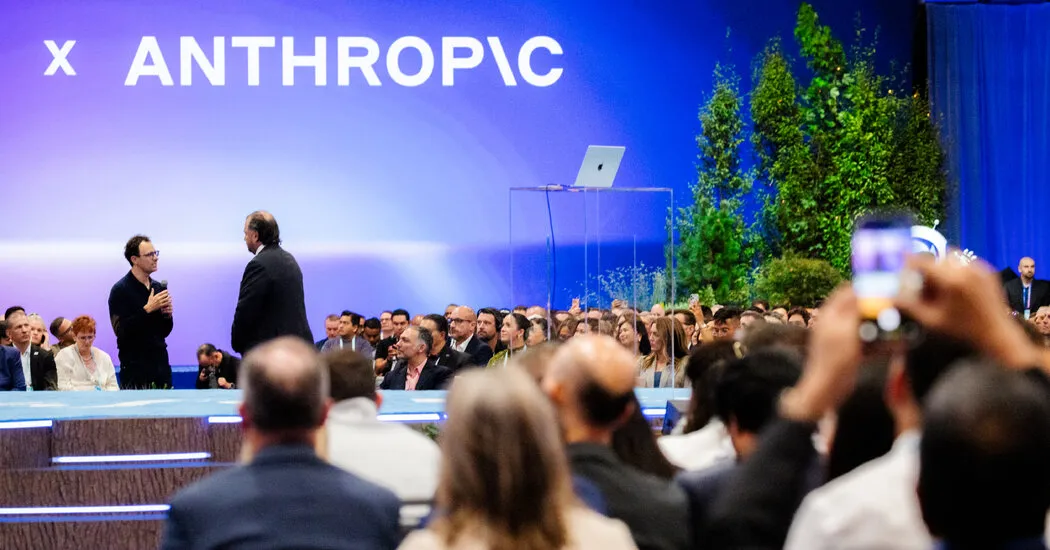
When Anthropic begins to list its shares for public trading on Thursday, the first-of-its-kind offering will double as a watershed moment for a fast-budding technology that may someday revolutionize American life.
But it will also spotlight the ways in which artificial intelligence has outpaced the federal government’s ability to prepare — and the vast economic consequences that could soon follow because Washington acted too late.
Despite an increasingly anxious public, the Trump administration and its departing Republican majority in Congress have done little over the past two years to address or mitigate the potential hazards of A.I., including mass job losses. They have opted to cheerlead the arrival of new technology while largely ignoring its risks, an approach that has encouraged economic growth while leaving workers and businesses at the mercy of an unpredictable transformation.
It is a tension that Anthropic itself has acknowledged as it looks to woo investors in what could be the largest, most anticipated public offering in history. The company’s official prospectus portrays A.I. as cataclysmic for “every area of human endeavor,” from medical research to military warfare, and describes its own inventions as rife with “catastrophic or existential” danger to life itself.
While policymakers in Washington have prepared a series of bills that aim to confront those threats, many remain stuck in Congress. That includes proposals that would help address the economic consequences of A.I. by aiding displaced workers and bolstering the federal safety net.
Members of Congress have similarly been unable to enact measures intended to contain A.I. security threats or deal with its implications for health care, education, the energy grid or the tax code. Frequently, the Trump administration has portrayed some of the proposed limitations on A.I. as unnecessary, while shrugging off concerns that the industry itself could fall victim to a financially costly bubble.
Glenn Hubbard, an economist at Columbia Business School who served as a top adviser to President George W. Bush, said Anthropic’s public offering evinced a series of truths — that the company has been “highly successful” and that “Washington remains fairly unprepared” for what’s ahead.
He likened A.I. to the arrival of electricity, the combustion engine and mainframe computing — some of the many moments over the past century that helped to “reinvent” the U.S. economy. But, Mr. Hubbard added, those transformations did not always occur equally and simultaneously for everyone, a precedent that once again looms large entering a new chapter of the digital age.
“In general, where I would give the administration low marks is thinking about the speed of technological change that’s possible and getting ready for it,” he said.
For the moment, the focus is on the first day of trading for Anthropic, whose arrival on the Nasdaq coincides with a moment of heightened scrutiny around A.I. and its pioneers. As the first frontier lab to be listed publicly, its trajectory will be closely watched — touching off additional I.P.O.s and a wave of new investment if it succeeds, or perhaps setting off a chain reaction that upends the industry if it fails.
The stakes are just as great for the U.S. economy, at a time when the breakneck pace of A.I. investment is powering much of the nation’s growth and driving outsize gains in the stock market. If Anthropic falters, the nation’s prime source of economic strength could stumble along with it. That risk was apparent this week, as major indexes whipsawed in tandem with Nvidia, a chipmaker at the center of the A.I. ecosystem, after the ouster of its embattled chief executive. It also reported a sharp uptick in quarterly sales.
The result is a “financial pressure” on Anthropic, said Amos Toh, a senior counsel at the Brennan Center’s Liberty and National Security Program. But, he said, it faced a contradiction: Its business model is “conditioned on accelerating the development of the technology toward an end state” that Anthropic itself has acknowledged could be “potentially catastrophic.”
That, to Mr. Toh, raised the key question: “How will this tension play out in A.I. regulation and efforts by Congress to regulate the technology?”
So far, at least, those regulatory efforts have largely faltered.
By the Brennan Center’s count, Democrats and Republicans in Congress have unveiled 56 major bills over the past two years seeking to address some of the greatest A.I. risks. The measures are wide ranging, aiming to create new federal oversight agencies, establish new reporting requirements for cybersecurity incidents and even mandates for a “kill switch” allowing federal regulators to shut off rogue A.I. agents. Some, like the Frontier Act, which looks to manage catastrophic A.I. risks, have the support of Democrats and Republicans.
But despite the support, only one of those measures has become law in Republican-controlled Washington. It was narrowly focused on thwarting sexually explicit, A.I.-generated videos, known as “deepfakes.”
There are additional bills that would address the economic consequences: tracking A.I.-related layoffs, retraining affected workers and augmenting their wages if they are cast from their jobs by technology. Lawmakers including Senator Ron Wyden, Democrat of Oregon, have focused on the safety net, and others including Senator Bernie Sanders, independent of Vermont, have sought to award the public a portion of the wealth generated by the likes of Anthropic as they hit public markets.
But those, too, have gone nowhere, meaning the largest I.P.O. in history is set to occur even though the government “doesn’t have the instruments to measure it, or the safety net to be prepared for what’s coming,” said Erik Brynjolfsson, a leading A.I. expert who heads the Stanford Digital Economy Lab.
Mr. Brynjolfsson’s organization has embarked on its own campaign to try to track the economic changes wrought by A.I. Its latest research, produced in conjunction with the payroll firm ADP, found continued evidence that young workers in A.I.-exposed industries were having a harder time finding employment.
It is a far cry from the projections that millions of workers could someday lose their jobs from wide-scale A.I. adoption, but Mr. Brynjolfsson said the correlation was instructive in a key respect: “A.I. is starting to accelerate its own development sooner than Washington has assumed.”
The inaction on Capitol Hill fanned anger among Democrats on the eve of the Anthropic public offering. Senator Elizabeth Warren of Massachusetts, who leads her party on the banking committee, expressed alarm in a statement about the “threats to Americans’ retirements and the entire financial system if this I.P.O. goes awry.” She said the Trump administration was “asleep at the switch.”
Voters appeared to echo some of that unease in this year’s elections, as they opted to restrict A.I. in dozens of ballot measures and topple candidates viewed as too friendly to the industry. Already, incoming Democratic leaders have promised an aggressive crackdown, including new moratoriums on data centers, which many communities have blamed for increasing pollution and rising utility prices.
“We haven’t seen the action to date yet, but I think there’s a growing appetite to act,” said Asad Ramzanali, the director of artificial intelligence and technology policy at the Vanderbilt Policy Accelerator, adding that for the “first time it feels like there’s momentum.”
But Democrats may face a potential obstacle in President Trump, who has likened data centers to “GOLD” on social media and broadly looked to court what he sees as the vast “riches” of A.I. He has resisted calls for any slowdown and celebrated the soaring stock returns of major technology companies, which he has chalked up to his administration’s hands-off policies.
The White House did not respond to multiple requests for comments.
Some investors and economists fear that the most significant lapse in Washington is an inattentiveness to the financing tactics powering A.I. development. To build new data centers and ramp up the technology, many companies are borrowing and spending staggering sums, raising the possibility that they may never earn enough revenue or attract enough customers to justify all of the investment.
Ben Harris, the vice president and director of economic studies at the Brookings Institution, said there was “not enough attention being paid” to these practices in Washington.
“A.I. could still be profitable, and we could still have massive stability risk, because it’s not as profitable as those who invested in it thought,” he said.
Among the biggest A.I. critics, there is even a fear that inadequate regulation could precipitate the sort of meltdown last seen during the global financial crisis, which could wreak havoc on workers’ retirement savings. But the Trump administration has rejected those fears as well, and in advance of the Anthropic public offering, it has repeatedly rebuffed calls for an intervention.
Such a situation unfolded in November as investors grew troubled over companies including Alphabet and Meta, and the scale of their A.I. spending. Despite a market rout, Kevin Hassett, the director of the White House National Economic Council, pointed that month to what he described as a “well-financed ecosystem.”
Mr. Hassett added in an appearance on CNBC that there were “five or six J.P. Morgans that could come in and swoop around and clean things up if need be.”
While he then predicted that would not be necessary, Mr. Hassett still added of the industry: “I don’t think that there’s a risk of a wholesale sell-off at all.”
