


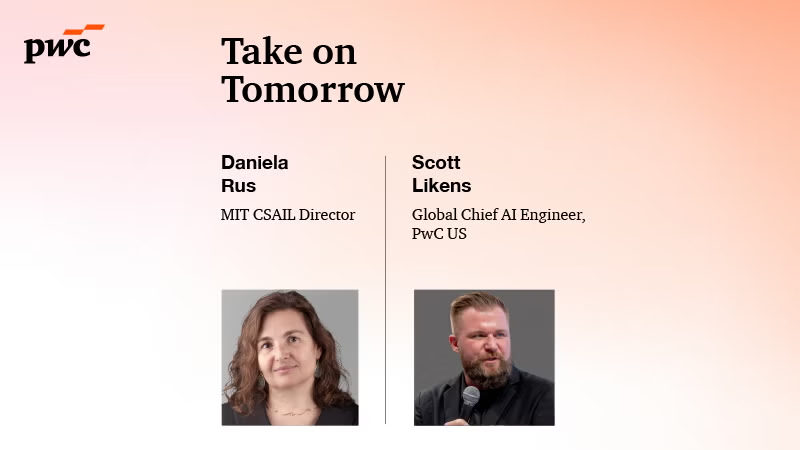
DANIELA RUS: Imagine a future where your tasks get automated. Maybe fresh produce shows up on your doorsteps, where roads maintain themselves at night, where garbage bins take themselves out.
SCOTT LIKENS: The reality is there’s devices all around us that are starting to use AI to make decisions or take action,
DANIELA RUS: When it comes to making, to moving, to growing, to building, to cleaning, to delivering anything, physical AI will reset the cost structure of companies.
FEMI: Could your laundry, food deliveries, and waste collection be done by robots in the future?
LIZZIE: It may sound far-fetched, but robotics are advancing at a rapid pace. As physical AI gets smarter, robots are able to better understand the world around them, unlocking new possibilities.
FEMI: So what could this mean for the way you do business?
FEMI: I’m Femi Oke, a broadcaster and journalist.
LIZZIE: And I’m Lizzie O’Leary, a podcaster and journalist. And this is Take on Tomorrow, the podcast from PwC.
FEMI: This episode… Are we entering a new age of robotics?
LIZZIE: Shortly, we’ll hear how AI is moving past the digital world.
FEMI: But first, to help us understand the business implications of this technology… we’re delighted to be joined by PwC’s Global Chief AI Engineer, Scott Likens. Scott, it’s great to have you back with us on take on tomorrow.
SCOTT: Great to be here.
LIZZIE: So Scott, we have talked on this show a lot about AI, but it’s almost always in the context of software and things that computer programmes do in a virtual world. But now we’re starting to hear more about physical AI. Can you help us understand what is that, and I guess, how does physical AI differ from robotics?
SCOTT: AI is now being put into physical things, and robots are the easy one to understand. They’ve been in sci-fi movies forever, but the reality is there’s devices all around us that are starting to use AI to make decisions or take action.
FEMI: Scott, so if you are a business leader and you have a company that doesn’t build cars or moves packages around, why should they be paying attention to physical ai?
SCOTT: Physical AI brings a new set of data to these models… This new set of data is going to allow us to create new predictive models. So now we can start to predict physics. We could start to predict at a molecular level what could happen. So I do think we’re gonna have much more advanced simulation modelling, much more advanced predictive modelling, which will really affect every industry. So the data is gonna make better foundational models, which could then be used more broadly, whether or not you’re using robots or it doesn’t matter.
FEMI: I’m also thinking about what robots in the future are going to look like and what are they going to do.
SCOTT: Yes
FEMI: So to get the answer, Scott, not just from you, but from a broader perspective, I spoke with Daniela Rus, who’s been working in this space for decades. She’s currently the director of the MIT Computer Science and Artificial Intelligence Laboratory, while also being co-founder of Liquid AI. That’s an MIT spinoff that’s making more efficient, general purpose AI systems. I started by asking Daniella, what is stopping robotics from being every day technology?
DANIELA: There’s a really interesting gap. Like a 4-year-old can tie shoe laces. A 2-year-old can grasp a strawberry without crushing it, or lift something very precisely. And a robot will have difficulty with all of these tasks. They do extraordinary tasks in industrial settings, but you can think of them as being pre-programmed. So what that means is that a robot engineer has thought about a task and has created a programme that can control the robot to execute that task. And in industrial settings, this will happen with extraordinary precision and scalability. But in a very narrow setting, if you change the task or if you change the environment, um, the programme will likely not work. So we can think of those machines as pre-programmed, but not necessarily intelligent and that means we have to compensate what the hardware cannot do with software, because you need both. The robot needs a body that is able to do the kind of tasks that you need that machine to do. And once you have that body, the robot also needs the brain to control the body to do what it’s meant to do. So this duality between body and brain for machines is very important.
FEMI: So intelligent robots in the future, are we talking five years, 10 years, 15 years? How far are we away from that reality?
DANIELA: It’s hard to put a timeline… First of all, we need more data about physical tasks. And data about physical tasks is very sparse. In the digital world we have all the writings ever produced, all the videos ever, ever produced, all the images. We have so much information, but we don’t have that same level of data for the physical world. The other part is that the models they have to understand physics and they cannot make mistakes. If you generate the wrong sentence in the digital space, you can just regenerate it. But if you generate the wrong move in a physical space, you might break your wall. The action, uh, could be irreversible. The inventions we need are skin-like, touch-like sensors, sensors that are able to understand forces and torques much faster and with a higher degree of accuracy and precision than the sensors we have today are. But, um, progress is very fast. The capabilities that don’t exist today may just as well exist tomorrow.
FEMI: Where are we already seeing examples of intelligent robots in our world?
DANIELA: We are seeing a lot of intelligent robots around us. If you have ridden in a self-driving car. Most likely if you order something online, a robot will touch your package at some point. And what we have to ask ourselves is what is the level of intelligence and of autonomy of these machines? For example, in surgery, the Da Vinci robot supports the efforts of a human surgeon by giving the human more precision, but the decision-making is still the human. So the Da Vinci robot, does a lot for surgery, but I would say it’s not intelligent because it’s not hooked onto a kind of an AI system, that gives it the ability to make decisions and take steps on its own. Most of the current digital AI solutions operate by statistics and by making forward predictions, they do not understand physics. So as part of physical AI, we need to improve how AI interacts in the world. The good news is that we already have solutions that are beginning to be commercialised, that, use, data that result in smaller models that can run on the body of the machine, and that understand physics.
FEMI: If we have intelligent robots, people are using them, business are using them, what is the added value that they bring to our business life and our personal life?
DANIELA: You can think about digital AI as giving people and organisations superpowers, so they can help you with speed, with knowledge, with insight, with creativity, with foresight, with empathy. We can get more precision in how we execute, uh, tasks. We get more strength. We can get the ability to overcome some of our physical limitations. For instance, I like Ironman. I’ve always wanted to fly like Ironman. Well, now thanks to the advancement of computation of materials and of robotic technologies, we can build exoskeletons that can enable each one of us to fly. Companies can use physical AI to improve cost and to improve efficiencies when it comes to anything that touches atoms, to making, to moving, to growing, to building, to cleaning, to delivering anything. Physical AI will reset the cost structure of companies. And it’s interesting to think about this moment in time with respect to AI and compare it to where we were, maybe two decades ago when we had a very similar point in time with respect to the digital transformation. The companies that were at the leading edge of adopting the digital transformation ended up being the leaders in their sectors. And so I really believe that with respect to AI and with respect to physical AI in particular, the companies who adopt these technologies will be at the cutting edge and will be the leaders of their sectors.
FEMI: If we step away from the business world and away from industry and we look at a very developed physical AI landscape, how would it change the way that we live?
DANIELA: Well imagine all your chores being offloaded to a machine. Imagine a future where your tasks get automated. Maybe fresh produce shows up on your doorsteps delivered by drones, where roads maintain themselves, at night, where garbage bins take themselves out and automated infrastructure ensures that they get removed. Imagine a future where our machines help us optimise all aspects of our work and our lives to make sure that we live well and we work efficiently. That is the promise that we have been, imagining and, and building towards.
FEMI: If there was one problem that you would like physical AI to solve, what would it be?
DANIELA: Hmm. I want , uh, physical AI to help us with healthier living and maybe healthier ageing. Every society on earth is getting older and there will never be enough caregivers. And there is the possibility of machines of the future that can help people stay in their own homes, that can help with lifting and fetching and monitoring and assisting, without replacing the human warmth and the human connection. And so that could really transform many lives. And I think we will all benefit from the advances towards healthy living. Can I have two? I want two.
FEMI: You can have two wishes.
DANIELA: My second wish is to ensure that our planet remains healthy. We live on this very special and beautiful planet alongside many neighbours. And by that I mean many plants and animals that form the ecosystem that have created the extraordinary environment we live in. And we want to make sure that the planet remains equally rich for all the future generations, but also for all our neighbours. And this is something that has to be done at scale and cannot be done by people alone. I would love to have machines that can clean our oceans and ensure that marine life, is healthy. I would love to see machines that can clean up all of our dump sites and the places, uh, where we are beginning to see environmental challenges.
FEMI: Daniella Rus, thank you for sharing your work and your wisdom with us on Take On Tomorrow.
DANIELA: Thanks, Femi.
FEMI: Scott, so many interesting ideas about what is possible, but obviously some of these examples are quite a long way off. What is it going to take really get that momentum going around robotics generally?
SCOTT: So we, we think they’re very far off, but I also think the pace has changed. So I think we’re making more progress than we have a decade ago, but I think we need momentum. And what you’re starting to see is different aspects of robotics. The humanoid robot that may help us at home or may work on a factory line. But then thinking beyond that, where can we actually start to infuse this throughout other systems? Could farming fundamentally change through robotics? I personally think as we get to space and, and we have a, if we have a moon base or a Mars base, we’re gonna have to have robotics to help the humans that are gonna live there, there, that’s inevitable. So I, I do think it’s a far way off. What we need today is, the things that are happening, the world models, moving beyond text and image, the general purpose models. And that’s been really a breakthrough for robotics, where they don’t have to be programmed. They can actually understand the environment through vision. They can understand and interact with objects. I think those things are starting to happen and it’s pretty exciting. But we also have to be safe and, and do it responsibly.
LIZZIE: I remember 10 years ago being on the factory floor of a number of different places that made carpets. Right. And there were robots moving around. But what I hear you saying is that the next generation of those could be robots that are seeing, that are taking in data, that are figuring out, I go over here, I make my delivery to this part of the factory. I wonder if there are industries that are furthest ahead now in putting physical AI to work. Like are there examples of industries where you think, oh, they’re doing this.
SCOTT: Yeah, as you mentioned, manufacturing has been using robotics, but it’s that pivot from robots that we precisely trained to do a task exactly the same way to robotics that can do any task. And they can see around them, they could use vision, they could actually reason through a solution, and they can optimise the plan to solve that. That’s a very big pivot. Manufacturing has been ahead because they’ve been investing in it for a long time. I like transport and logistics self-driving cars, taxi cabs, and that starts to permeate to trucking. That could permeate to buses, that could permeate, maybe to airplanes. So I think it starts to permeate more and more industries as the trust builds,
FEMI: So who is not using physical AI that absolutely should be. Who’s not quite seeing the potential right now?
SCOTT: Well, I would say everyone, we’re not using it enough in transport and logistics. Agriculture, um, to me is a, is a no brainer. Healthcare I think could take advantage of it much more. We’re not using it enough in manufacturing. Even the industries that are ahead are not using it enough. Some of it’s fear and uncertainty around, uh, around the trust. Some of it could be investment or just priority, but I, I think even in the industries that have started, it’s still not at full scale. And I think we’re starting to see the early signs that, it will scale. But the investment in actually building these physical AI robots, has to increase.
LIZZIE: I think one of the questions when we talk about adopting bold ideas, which is kind of the, the through line of this series is where can leaders use technology, not just to automate things that they already do, but to actually solve problems or create opportunities that didn’t exist before and weren’t possible before this kind of tech.
SCOTT: I think we’re in this era of continuous learning, continuous experimentation so that whichever way the world pivots, we can be ready. So I think that ability to, to change, strategies more quickly because you have the tools in place, is the most critical business strategy ahead of us. The ability as you, for you as a leader to make decisions, and to solve problems that you didn’t even know you had. And I think that’s a, a different fundamental construct than most enterprise organisations deal with. They, they know their business, they optimise it, they squeeze out costs, they increase revenue, they go to more markets. They’re known patterns, but the world ahead of us are unknown patterns, as we start to see some of these things connecting in, in ways we couldn’t imagine. So, having that agility to really react to anything that we need to solve ahead of us.
FEMI: There are so many impressive examples of robotics and physical AI online, on social media, and I probably spend way too much time on social media. But the examples of really impressive and then the comments are, ‘our robot overlords are going to kill us’. And that is a, a genuine concern from people who are not specialists. Is that part of the trust part of this equation that everybody needs to understand that robots are not going to kill us, hopefully…
SCOTT: I mean, it has to be part of the conversation. The reality is right now, there’s not a lot of standards. Because physical AI can actually interact with us as humans in the real world, it’s even more important. So I think you have to look more broadly than the robots because what’s happening is physical AI is accelerating on the back of generative AI and the foundational models, which are getting more and more intelligent, probably at a pace, most people would not have guessed, maybe,
LIZZIE: And hacking each other.
SCOTT: They’re hacking each other. They’re working together in swarms. And that’s my point. That we can understand, it’s happening in the cloud and we can, we can shut it off or we can sandbox it. Now when there’s something physical that’s stronger than us, faster than us, we can’t get that wrong. So that’s why it’s so important to put these guardrails in place.
LIZZIE: What does responsible physical AI actually look like in practise though? Because, you know, we are talking about companies that work across regulatory environments where there are very different standards or companies that are competing against each other. Like, how does one create that in, in such a complicated world?
SCOTT: To be honest, we’re trying to figure some of that out now. I think there’s a few, a few key aspects. One, we have to understand everything that machine is doing. So every decision it made, every movement, the reasoning that went in, we have to be able to capture that so that we can understand over time what decisions are being made and why. Then putting the guardrails in place, it probably does take some regulation, which I’m not sure there’s enough of, to say what are the types of tasks and things that these robots should or shouldn’t do.
LIZZIE: Finally, Scott, what are your two or three top tips for businesses if they’re thinking about integrating physical AI and robotics into their organisations?
SCOTT: I always start with safety and being responsible. So I think you as an organisation have to approach this with, trust by design and in design. Then I, I think about, integrating this into your business is, is really gonna be similar to how we’ve done synthetic robots or agents, but having the right skills and workforce to understand that, um, how are you gonna evolve your workforce to work in a hybrid environment?
FEMI: Thank you, Scott. It’s been such a pleasure chatting with you.
SCOTT: Thank you.
LIZZIE: That was such a completely fascinating conversation, and I think it’s still requiring me to work to get my head around the idea that a robot could see something, take in information, and then make decisions all on its own. It’s both amazing and terrifying and fascinating, and all of the above.
FEMI: What I found reassuring Lizzie, is that we’ve been here before and all the technology and the advances that we were terrified of in the past, even like an escalator, or a lift, or getting onto an airplane, is everyday activity. But how exciting to be able to be at this point and know that our lives and the way that we operate with robotics is absolutely going to change. But we’re not quite sure how!
LIZZIE: And quickly.
FEMI: Very quickly. I’m waiting for my robotic husband…(laughs)
FEMI: Well that brings us to the end of this week’s episode – for more on how to build momentum around bold ideas, follow Take on Tomorrow wherever you listen to podcasts. Just remember to go to pwc.com/takeontomorrow.
LIZZIE: Next time… How can business turn a lack of infrastructure into an advantage?
WALE: You don’t need a big power plant outside of town, a hydro plant somewhere, or a coal power plant to be able to actually get electricity to people.
We hear how leapfrog technologies are changing lives.
FEMI: Take on Tomorrow is brought to you by PwC. PwC refers to the PwC network and/or one or more of its member firms, each of which is a separate legal entity.
