


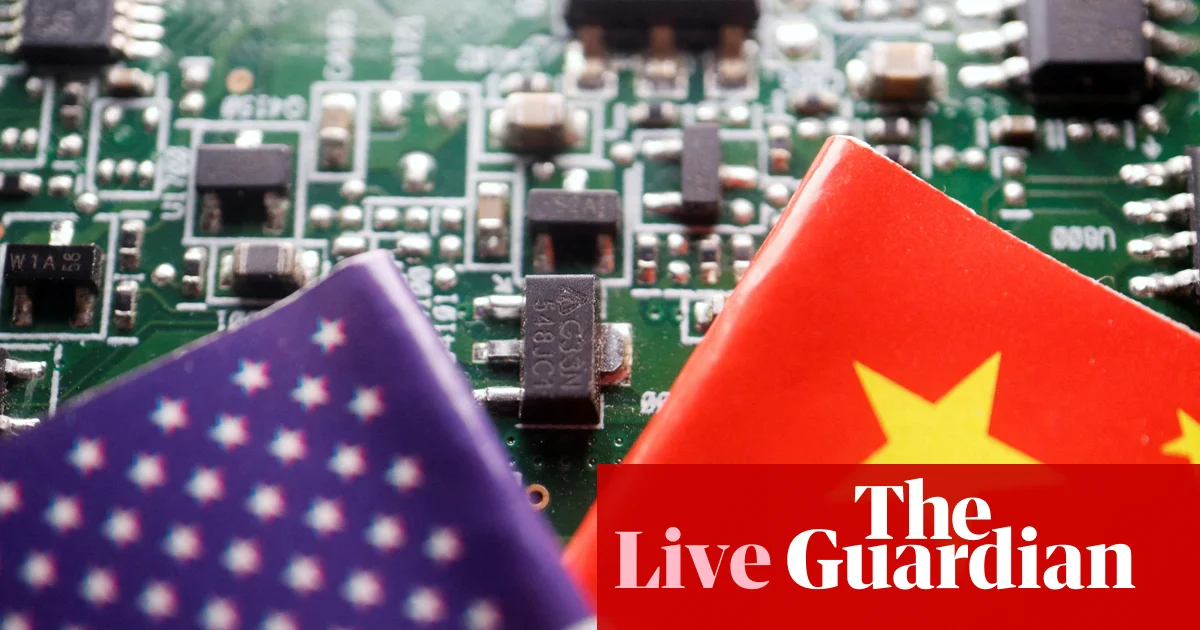
China slams new US chip curbs and pledges ‘necessary measures’
China has threatened to retaliate against the US after Washington tightened restrictions on remote access to AI chips and servers.
At a press conference on Tuesday, China’s foreign ministry spokesperson Guo Jiakun said Beijing would take “necessary measures” to safeguard its own interests, saying:
double quotation mark“The US has repeatedly overstretched the concept of national security, abused export controls and even interfered in China’s normal trade and technological cooperation with other countries, unjustifiably suppressing the development of China’s high-tech industries.”
Guo also called the US move a typical example of economic coercion that deviates from the consensus reached by both countries, Reuters reports.
As we blogged yesterday, the US Commerce Department has issued a new rule which limits remote access to advanced artificial intelligence chips by companies in Singapore, Thailand, Malaysia, Indonesia and Brazil.
The new measure closes a loophole which allowed Chinese companies to access cutting-edge US tech by using data centres based in other countries in Asia.
Awkwardly for Beijing, the new “interim final rule” is being imposed just as Donald Trump prepares to meet China’s president Xi Jinping later this week in Shenzhen, which is hosting this week’s APEC summit.
Dexter Roberts, a nonresident senior fellow at the Atlantic Council’s Global China Hub, says (via Bloomberg):
double quotation mark“This is the worst situation possible for China because the last thing they want to see is any new restrictions on their access to chips.”
“Export controls are what upset them practically more than anything else right now other than maybe Taiwan.”
Share
Updated at 05.49 EST
Key events
US government confirms investigation into Megaspeed over Nvidia chip exports
Two US government departments have confirmed they are investigating computing company Megaspeed, suspecting it of violating US export controls by helping to ship tech giant Nvidia’s chips to China.
A joint statement issued by the Department of Commerce and the Department of Justice explains that Megaspeed has been under investigation since 2024, for “potential export control violations.”
In May 2025, Department of Commerce investigators requested records from Nvidia concerning direct or indirect sales to Megaspeed. In June 2025, Nvidia placed Megaspeed on its “no sell” list, they explain.
And they also state that commerce department agents conducted an on-site, in-person, end-use check at Megaspeed in June 2025 and interviewed CEO Alice Huang.
The Department of Justice then took the lead role in the criminal investigation of Megaspeed.
Tooting their own trumpets, the departments add:
double quotation markThis investigation is the result of the excellent work of the Department of Commerce under Secretary Howard Lutnick and the law enforcement efforts of the Department of Justice under Attorney General Todd Blanche.
That, presumably, is a response to suggestions that Lutnick could be fired following accusations that he had shielded Nvidia from federal oversight, and had failed to blacklist Megaspeed.
Share
US President Donald Trump has said that Nvidia’s new national security initiative is a good idea, while speaking in Manila.
Share
Nvidia establishes National Security and Export Control Oversight Committee
Nvidia has announced it is creating a new committee to oversee its national security policies, check it is complying with export controls and manage its global trade risk effectively.
The National Security and Export Control Oversight Committee demonstrates that Nvidia is committed to “the highest standards of governance and oversight,” the company says.
It’s a response to claims that billions of dollars worth of the company’s top AI chips have been redirected to China.
Harvey Jones, chairman of Nvidia’s board of directors.
double quotation mark“NVIDIA recognizes that advanced silicon technologies and the emergence of artificial and superintelligence present unprecedented challenges for national security.
As the world’s leading advanced computing company, NVIDIA has both a responsibility and an opportunity to lead the industry in addressing these challenges.
We are committed to working constructively with government and industry partners to help establish and advance a robust framework that uses every tool at our disposal to safeguard national security while supporting continued technological innovation.”
Share
Investors’ euphoria over the AI boom is over, according to the latest survey of fund managers from Bank of America.
BofA’s monthly poll has found that investors have slashed their technology holdings this month. The percentage of investors who were ‘overweight’ on tech stocks fell at the fastest rate since 2006 in November.
Photograph: BofA
The survey also found that 38% of investors predicted that bonds issued by AI hyperscalers are the most likely source of a credit event, followed by private credit with 30%.
BofA investment strategist Michael Hartnett says investors remain bullish on the macro-economic front, with just 3% predicting a recession. They are also optimistic about markets, with cash holdings at an “uber-low 3.6%”.
Share
EU charges Temu with illegal items failints
Jennifer Rankin
Newsflash: The European Commission has charged online shopping retailer Temu with failing to tackle the sale of illegal products, my colleague Jennifer Rankin reports.
The EU regulator found that the Chinese online shopping website did not have effective controls to prevent the sale of illegal items, thereby breaching the EU’s Digital Services Act.
Temu has been contacted for comment. The company now has the right to see the charge sheet and mount a defence.
The charges, announced on Tuesday, come after a €200m (£173m) fine on Temu from the EU in May on the grounds of inadequate risk assessment in 2024 to prevent the sale of illegal products and recommender systems that could amplify the promotion of such items.
The latest charges were brought under a different article of the EU’s Digital Services Act, which is intended to protect European internet users from online harms ranging from disinformation to cyberbullying to dangerous goods. They also relate to harms over a longer period, dating since the relevant provisions came into effect in October 2024.
Commission officials said Temu’s “ineffective” controls to stop illegal goods focused on paperwork, rather than products. It also found there were not enough human moderators to manage the huge growth in items listed on the platform. Third-party sellers offering illegal products, EU officials said, faced only weak sanctions from Temu and company systems enabled repeat offenders to sell through other parts of its website.
Temu has 130m users in the EU. If the charges are upheld Temu could be fined 6% of its global annual turnover.
The company said in May it disagreed with the Commission’s decision and saw the €200m fine as disproportionate.
The Commission examined Temu’s risk management systems, rather than specific products. Consumer groups in the EU and UK have previously reported that Temu has offered for sale baby toys presenting choking hazards, jewellery laced with dangerous metals including lead, clothes made with banned chemicals and illegal weapons.
Share
Singapore has said it is carefully studying the new US clampdown on Chinese companies renting computing power from data centres powered by Nvidia chips, in countries including Singapore.
The Singaporean government has said:
double quotation mark“We take our international reputation seriously and do not condone companies using their association with Singapore to circumvent or violate the laws of other countries in their international business activities, including export controls.
The scandal “is obviously not a good look for Singapore“, Chong Ja Ian, a political scientist with the National University of Singapore, told the AFP newswire.
Singapore is also probing what Megaspeed was up to, but Chong said the city-state must strengthen regulatory oversight to avoid the perception of “systemic issues”.
Share
Updated at 05.53 EST
Concerns that the AI boom may slow is pushing down the copper price today.
Copper has fallen to its lowest level in four and a half months, touching $13,144 a metric ton on the London Metal Exchange this morning.
Copper is heavily used in the AI industry – both to build data centre infrasctructure, and to cool the systems. It is also essential in power networks.
Share
Yohannes Lowe
The US president, Donald Trump, has arrived in Manila, the capital of the Philippines, for the Association of Southeast Asian Nations (Asean) summit,.
After departing from the Boeing 747 gifted to him by Qatar, Trump was greeted by officials and members of the military on the red carpet laid out on the Ninoy Aquino International Airport’s tarmac.
My colleague Yohannes Lowe is blogging all the key developments:
Demonstrators have also gathered in Manila to protest against Trump:
Photograph: Firdia Linsawati/AP Photograph: Firdia Linsawati/APShare
After a tough day yesterday, when they fell over 4%, Nvidia’s shares on track to dip further.
Nvidia’s shares are down 0.5% in premarket trading, ahead of their latest financial results tonight.
Daniela Hathorn, senior market analyst at capital,com, says:
double quotation markInvestors are expecting revenue of around $109bn, but the focus will be on data-centre demand, margins, forward guidance and reassurance about the company’s leadership transition.
Strong results could help restore confidence in the AI sector, although even an earnings beat may not be enough if management fails to address concerns about future investment returns. Conversely, disappointing guidance could accelerate the selloff.
Share
European stock markets are down across the board today, after a weak session in the Asia-Pacific.
The pan-European Stoxx 600 index is down 0.9%, with losses on the main indices in Frankfurt (-1%), Paris (-1%), Madrid (-0.5%) and Milan (-0.6%) as well as London (-0.8%).
Overnight, South Korea’s Kospi index dropped by another 2.6% as stocks linked to the AI sector continued to be hit.
AJ Bell investment director Russ Mould says:
double quotation mark“Despite its limited exposure to AI, the UK market could not entirely shake off the negative sentiment in markets as tech stocks chalked up further losses,” says
“Asian markets experienced further weakness and London’s contingent of heavyweight resources stocks also came under pressure as commodity prices eased.
“While US futures are pointing to a steady start on Wall Street later, the tone for the remainder of the week will hinge on Nvidia’s earnings update after the bell.
Share
The US has added “another layer of regulatory risk to the global AI trade” by tightening restrictions on China’s access to advanced AI computing through overseas data centres, says Charu Chanana, chief investment strategist at Saxo.
In a new research note, Chanana explains:
-
China AI is no longer one trade. Domestic semiconductor suppliers could benefit from the self-sufficiency push, while AI developers face higher costs and potentially slower innovation.
-
Nvidia and US tech face indirect risks. Nvidia’s reported China revenue may not fully capture demand routed through overseas data centres. The bigger question is how restrictions affect future AI infrastructure orders.
-
Could regulation become the next big AI risk? Restrictions could eventually extend beyond chips and computing access to Chinese AI models. That could raise costs for businesses using cheaper Chinese models and slow AI adoption — the phase where we expect broader economic value to emerge.
Share
Tension rises ahead of Nvidia’s results tonoight
Any set of financial results from Nvidia are important, but there’s particular excitement in the markets today before the chip giant publishes its third-quarter results after Wall Street trading ends tonight.
Nvidia’s Q3 results, and the subsequent conference call with analysts and investors, will be very closely scrutinised given the crisis gripping the company.
Nvidia’s future forecasts will be a key measure of whether the AI industry is growing as rapidly as forecast.
But it will also, surely, be quizzed over the resignation of Jensen Huang last week. Will the board confirm that there is no chance of a return for Huang, who quit after reports of extramarital liaisons, including with an alleged Chinese spy, Alice Huang?
Interim CEO Colette Kress could also face questions about reports that $12bn of Nvidia’s chips were directed to companies in China by Megaspeed, Alice Huang’s company.
Kress might also be quizzed about reports that she is concerned about Nvidia’s web of financial support for AI companies….
Investors may also wonder whether the latest clampdown on remote access to AI chips – which have irked China – will hurt Nvidia’s sales.
Kathleen Brooks, research director at XTB, explains:
double quotation markThe question is, can they calm investors’ nerves about the AI trade? The market expects another monster report. Expectations are for revenue to come in above $109bn for last quarter, a jump of 92% on a YoY basis, earnings per share is expected at $2.47. There is no reason to think that Nvidia will miss these figures, and based on the recent trend of their results, they are likely to post sales figures above expectations.
Although profit margins could dip to 73% from 74%, the company is still likely to report a bullet proof balance sheet, with over $180bn in free cash flow. Nearly all AI companies use Nvidia chips, so the question is: will export restrictions to Asian countries that have acted as conduits to China have a material impact on the company’s revenues going forward?
Share
