


Free Newsletter
Get the hottest Fintech Singapore News once a month in your Inbox
The insurance industry stands at an inflection point as uninsured losses and liability claims continue to rise.
Through 2030, these risks are expected to surge further, with cybersecurity poised to become the top business insurance risk, surpassing natural disasters, mortality, and healthcare, according to a new report by Japanese information technology firm NTT Data.
This shifts indicate that emerging, technology-driven threats are expanding faster than traditional underwriting and risk management models can adapt.
In 2023, the protection gap for cybersecurity stood at US$171 billion. That figure is projected to grow more than fourfold, reaching US$743.75 billion by 2030, positioning cybersecurity as the largest source of uninsured risk. A protection gap refers to the difference between the amount of financial risk individuals or businesses face from potential losses and the amount of that risk actually covered by existing insurance policies.
Rising cyber threats
This widening cybersecurity protection gap is driven by rapidly evolving threat sophistication, particularly those leveraging artificial intelligence (AI). These sophisticated attacks are outpacing organizations’ ability to update defenses and insurers’ ability to adapt products.
A global 2025 Boston Consulting Group (BCG) survey of 500 senior leaders highlights the scale of exposure. 53% of executives ranked AI cyber risks among their top three organizational risks, with about 60% of leaders believing they have already encountered an AI-enabled attack.
Across industries, AI-enabled scams and breaches are producing multimillion-dollar losses, operational disruptions, and regulatory fines. In January 2024, a finance worker at a multinational firm was tricked into paying out HK$200 million (US$26 million) to fraudsters using deepfake technology to pose as the company’s CFO in a video conference call.
In the US, AI-enabled scams accounted for 22,364 complaints to the FBI’s Internet Crime Complaint Center (IC3) in 2025, costing Americans nearly US$893 million. Schemes included investment, romance, and employment scams, as well as emails impersonating a company’s CEO or other officials that contain phishing links or directions to wire funds.
According to IBM’s 2025 Cost of a Data Breach Report, the average breach cost in the healthcare industry amounted to US$7.42 million in 2025, making it the most expensive industry for breaches for the 14th consecutive year.
The cost of a data breach by industry, Source: Cost of a Data Breach 2025 Report, IBM
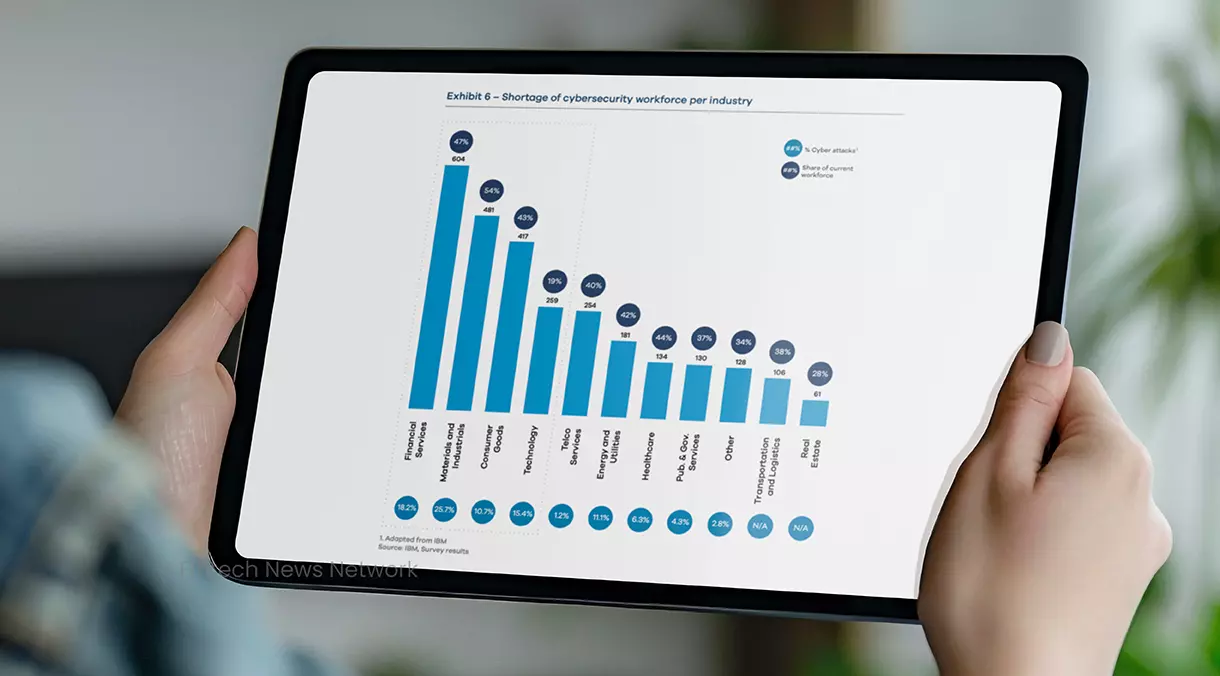
The issue of surging cybersecurity threats is further exacerbated by the talent shortage. Despite an annual investment of nearly US$200 billion annually in cybersecurity products and services, businesses are struggling to keep pace with escalating cyber threats, with only 72% of cybersecurity roles being filled, according to a 2024 report by Boston Consulting Group (BCG) and the Global Cybersecurity Forum (GCF),
That year, the global cybersecurity workforce stood at 7.1 million professionals, leaving a shortfall of 2.8 million. Approximately 64% of this workforce shortage was disproportionately concentrated in four industries: financial services, materials and industrials, consumer goods, and tech, a concentration that’s unsurprising given that these sectors were the targets of approximately 70% of all global cyber attacks.
Shortage of cybersecurity workforce per industry, Source: 2024 Cybersecurity Workforce Report, Boston Consulting Group (BCG) and the Global Cybersecurity Forum (GCF), Oct 2024
Other major risks
While cybersecurity dominates, other major risk types are also expected to increase, albeit to a lesser extent. Natural disasters, which boasted the biggest projection gap in 2023 at US$273.8 billion, are expected to see that gap widen, increasing by 46% to reach US$399 billion by 2030. The figure will make it the second-biggest risk after cybersecurity.
After natural disasters comes healthcare, with a protection gap anticipated to grow 47% from US$206.8 billion in 2023 to US$304.5 billion in 2030. This would rank healthcare third.
Mortality is set to witness the most moderate growth, with the protection gap expected to rise 29% from US$229.6 billion in 2023 to US$296.8 billion in 2030.
Projected protection gap 2030, Source: Insurtech Global Outlook 2026, NTT Data, Jun 2026
Growing protection gaps are creating demand for innovation. As traditional insurers struggle to profitably cover certain risks, opportunities are emerging for newer market players, driving an increase in initial public offerings (IPOs) within the insurance and insurtech industries.
Insurtech and insurance IPOs, Source: Insurtech Global Outlook 2026, NTT Data, Jun 2026
It’s also driving demand for new technologies including AI and agents, which are poised to deliver cost savings in automation and process optimization of up to 35% for insurers. Although 82% of insurance leaders view AI as a top business imperative, adoption remains subdued, with only 22% of insurers having scaled AI to the production phase, even as 66% of the insurance workforce has adopted AI tools.
Featured image: Edited by Fintech News Singapore, based on image by freepik via Magnific
