


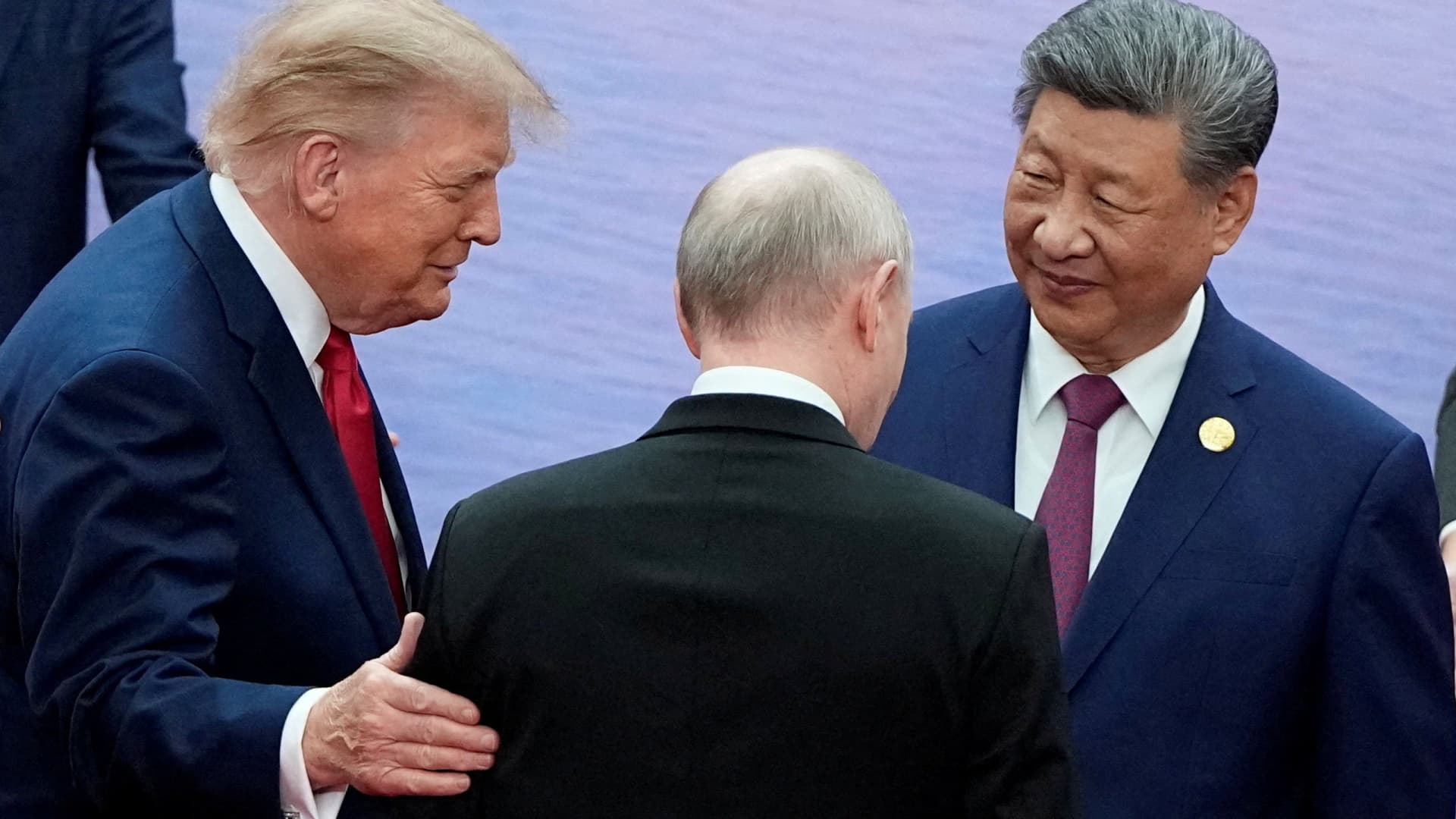
US President Donald Trump, Russian President Vladimir Putin and China’s President Xi Jinping attend a photo session before the welcome banquet at the Asia-Pacific Economic Cooperation (APEC) summit in Shenzhen, Guangdong province, southern China, November 18, 2026.
Iori Sagisawa | Via Reuters
SHENZHEN, China — For a second year in a row, Chinese President Xi Jinping has brought Russian President Vladimir Putin together with another major world leader on mainland Chinese shores.
U.S. President Donald Trump had a trilateral meeting with Xi and Putin on Thursday, after the three met the prior evening during a welcome banquet for the Asia-Pacific Economic Leaders’ Meeting in Shenzhen. It marked the first time they had met together in person.
In September 2025, Xi, Putin and Indian Prime Minister Narendra Modi briefly laughed together for a friendly photo-op alongside an annual meeting of the Shanghai Cooperation Organization in Tianjin, China. The gathering followed easing tensions between Beijing and New Delhi.
Summit diplomacy
China’s “ability to engage directly with the world major powers” reflects the country’s influence across the Global South and Eurasia, said Jodie Wen, postdoctoral fellow at the Center for International Security and Strategy at Tsinghua University. “China hopes to play a more constructive role in this conflict-[ridden], unstable world.”
In the future, “China will hope to provide more platforms” within its borders for countries to discuss issues, she said.
Latest from APEC Shenzhen
China has increasingly played the role of broker, for instance, providing the forum for restoring diplomatic ties between Saudi Arabia and Iran in 2023.
By participating in and hosting different multilateral organizations, China has stayed in the Western orbit while cultivating relations with non-Western countries. The two photo-ops last year and this year reflect only a portion of Xi’s large number of meetings with different world leaders.
Xi has hosted more than 40 heads of state so far this year, including at least eight around the APEC meetings in Shenzhen this week. That’s on top of receiving over 60 state visits in 2025, according to CNBC analysis of official Chinese readouts.
Domestic Chinese media have highlighted how Xi has met with many foreign leaders around the China-hosted events.
“Beijing sees these multilateral platforms as opportunities to expand its international influence and demonstrate its commitment to multilateralism, while bilateral diplomacy remains equally important,” said Yue Su, principal economist for China at EIU.
But she noted that different countries increasingly pursue different geopolitical and economic priorities, making it challenging to reach consensus even through multilateral organizations.
“Against this backdrop, China’s diplomatic priorities are increasingly focused on delivering tangible economic benefits through trade, investment, financial connectivity and technology cooperation,” she said.
APEC outcomes
On Thursday, Xi announced at the APEC Economic Leaders’ Meeting that China would provide $20 million in support for the Asia Pacific region. He also advocated for the development of an “Asia-Pacific community with a shared future,” an iteration of his commonly used slogan on a “shared future” for humanity more broadly.
The Shenzhen summit can create meaningful outcomes for crisis management, as well as diplomatic space for future negotiations, Tsinghua University’s Wen said. She added that it’s important for leaders to come together in person in order to avoid misunderstandings and further tensions.
Trump said Thursday at the trilateral that the U.S., China and Russia are “uniquely positioned” to discuss reducing nuclear weapons at their historic meeting. A Chinese readout subsequently said the three leaders discussed Ukraine, the Middle East and the Korean Peninsula.
—CNBC’s Matthew Tan contributed to this report.
