
Since its founding in 1957, GreenShield has been a nonprofit, focused on responding to the evolving healthcare and insurance needs of Canadians, while pursuing its social mission of Better Health for All. The fourth largest Canadian private health and dental insurer, with 7.5 million Canadians served, has a nonprofit structure that allows the organization to reinvest its earnings to extend its social impact. Since 2018, GreenShield has navigated major challenges, including the Covid 19 pandemic, while deliberately transforming from a traditional insurer into Canada’s first payer‑provider. Today, it delivers insurance, administers benefits, pays claims, and provides health services through one integrated, seamless system. GreenShield’s early investments in telemedicine, mental health services, and a digital pharmacy, including its own
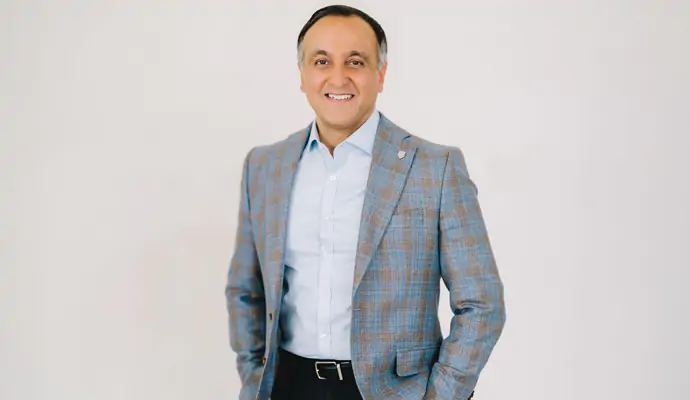
in‑house platform, have paid off. This growth has strengthened the organization’s ability to advance its social mission. President and CEO Zahid Salman, who joined the company in 2018, spoke with strategy+business about how the company is expanding into the healthcare ecosystem and focusing on responding to the evolving needs of Canadians.
Related insights
S+B: Insurance—along with the healthcare system at large—is moving from an industrial silo into a larger domain centered around how we care for ourselves. And to be effective, healthcare needs to be more proactive and personalized. How has the role of an insurer like GreenShield evolved in this world?
ZAHID SALMAN: The Canadian landscape is unique in that there’s a historical separation between insurance companies and healthcare providers. Roughly two-thirds of healthcare is delivered through the public system—primarily doctors and hospitals—and funded by the government. The remainder falls outside the Canada Health Act, and for decades insurance companies have provided coverage for services such as prescription drugs, paramedical care, and mental health. Employers offer these benefit plans to attract and retain talent, and they partner with organizations like ours to deliver that coverage.
Even before the pandemic, we had a working hypothesis that insurers could play a broader role—not just to deliver coverage, but in delivering care as well. We looked to the US for inspiration, where organizations such as CVS and Aetna, UnitedHealthcare and Optum, and Kaiser Permanente blend elements of payer and provider into more integrated models.
S+B: What is the value proposition to being both a payer and a provider?
SALMAN: We start with our social mission, which is to improve access to healthcare for all Canadians. We were founded by a pharmacist who created North America’s first pre-paid drug plan and established GreenShield as a nonprofit to administer these plans. From the beginning, our model has been about growing our business to improve health outcomes. As a nonprofit, we’ve historically taken our excess earnings and donated to other charities. Now, as a payer-provider, we ask: how can we deploy our services to support underserved communities, and what services will make the most impact? We use a sustainable business model—as we grow, we strengthen our ability to reinvest, scale solutions, and deliver measurable change. As we often say, no margin, no mission. Healthcare delivery offers stronger margins than claims adjudication alone, which allows us to reinvest more meaningfully in our mission.
S+B: When did this start?
SALMAN: Before the pandemic, we started to invest in digital health providers such as virtual mental health, digital pharmacy, and pharmacogenomics. At that stage, the goal was to test and learn and integrate these services into our benefit plans. We were seeing encouraging traction. Then the pandemic hit, and the environment shifted quickly. Clinicians’ offices closed, and employers were coming to organizations like ours with a simple yet urgent question: how do we help their people access care? Digital health adoption in Canada went from single digits to nearly 70% at the peak of the pandemic. We expected that number to normalize, but we knew it wouldn’t return to where it had been.
That moment accelerated our acquisition strategy. After having completed no acquisitions in our first 65 years, we made eight in 18 months to intentionally build out our payer-provider platform—bringing in digital health services that were most aligned with the claims we pay and the benefits we cover.
S+B: The purpose of the deals was not to buy more scale in the core business, but to get new capabilities?
SALMAN: Exactly. Our intention was to establish that first-mover advantage because we compete in an environment with large competitors. In Canada, there are the big three insurers who own roughly two-thirds of the market. We’re the fourth biggest for health and dental. Part of our hypothesis was that this approach would both strengthen our core insurance business—by helping plan sponsors introduce more integrated services—and allow us to diversify into healthcare markets aligned with our social mission. When we started this diversification journey in 2018, we had approximately CA$2.3 billion in gross revenue. By the end of 2025, that figure had grown to $6.2 billion—an increase of roughly 2.5 times. Over the same period, our annual social impact contributions have increased sevenfold. Business success has enabled us to significantly scale the impact we have as an organization.
S+B: The core insurance business is about collecting premiums and processing payments. But in the past several years, you have built out a consumer-facing ecosystem. What drove this transition?
SALMAN: Before we started to make acquisitions, we did research to understand where the real pain points were. One trend that spoke loudly to us was the fact that 75% of Canadian employees want easier access to health professionals and simpler claims reimbursement processes, citing frustration with the current complexity. Bringing coverage and care into a single ecosystem, where our claims adjudication platform could seamlessly integrate the reimbursement of healthcare services within that ecosystem, became a powerful value driver.
Another major pain point was access. The public health system has been under strain in Canada. Almost one in five Canadians don’t have access to a family doctor. And for those who do, at least a third of them take over a week to get an appointment. That reality shaped our value proposition—starting with access and convenience. We built GreenShield+, an ecosystem that integrated coverage and care all in one app, making it easier for people to get the support they need when they need it.
S+B: And then you layered in new acquisitions?
SALMAN: Yes. We acquired two mental health companies—Inkblot, which provided counseling, and Tranquility, which offered cognitive behavioral therapy [CBT]. We then combined them to build a more comprehensive digital mental health program. After that, we expanded into telemedicine via a deeply embedded partnership. And because a large share of the claims we reimburse are for medications, we also acquired a digital pharmacy and a specialty pharmacy and integrated all of these services into GreenShield+. Most recently, we acquired Kii Health’s Canadian mental health services segment, integrating its digital capabilities and practitioner network within our platform to build a stronger, more connected pathway to care.
Imagine it’s the middle of the night and you need care for a severe headache. Through the app, you can connect with a doctor within 24 hours. If medication is needed, the prescription can be filled by our integrated digital pharmacy and delivered to your door. If the doctor identifies anxiety as the underlying issue, you can immediately connect with a mental health professional or CBT tools—all within the same platform on your phone. And when it’s time to be reimbursed, the claims adjudication system is fully integrated into the app as well.
S+B: I can see how that leads to greater convenience. How does that lead to more growth?
SALMAN: It leads to more growth via two different sources. First, because of this integrated payer-provider model, we’re winning a lot more insurance business. Second, the way most of these services are paid for is by plan sponsors who put them in benefit plans on a subscription basis. You typically pay a per-employee, per-month charge to cover your full population. As more employers add these healthcare services, that subscription model becomes a meaningful and scalable source of revenue.
S+B: What you’re describing is a model that brings together many parts of the healthcare and benefits experience into one unified system.
SALMAN: There was an article that hypothesized what the world’s most valuable companies might look like in the future—pointing to organizations that are integrated across healthcare and insurance spaces while also reinventing the patient experience across multiple healthcare providers with the patient at the center of their journey. Now, we’re not going to be the biggest company in the world, but that framework resonates with our value proposition. It’s about reinventing the plan member and patient experience to make it more proactive and personalized.
S+B: What were some of the key steps you took to get there?
SALMAN: We’ve gone through a significant digital transformation, moving from largely an on-premises environment to the cloud. Today, data from across our services resides in a common place, which allows us to access it and run next best actions, next best offers, to the extent we get the appropriate permissions from individuals. That makes it more of a proactive and personalized experience. When an individual comes with a specific problem, based on what we know about them, we can recommend other considerations or services to improve their overall health.
S+B: And how do you demonstrate the success of this approach to your customers—the organizations buying your insurance?
SALMAN: The value proposition is integration and health outcomes. If we can demonstrate that we are improving overall well-being at both the plan sponsor level (who’s paying for the bulk of the services) and then at the plan member level (who’s consuming the services), that will drive more engagement and more investment.
We track reduction in absences and short- and long-term disability. These are the most obvious quantitative areas to see if our preventative services work. If we can bend the curve on absences, then the premiums that we—and the whole industry—charge would have to decrease.
S+B: How specifically did your digital transformation deliver efficiencies and synergies in operating your business?
SALMAN: One is internal efficiency. Our digital transformation has enabled significant productivity gains by simplifying how the organization operates. Before, we relied on multiple systems that didn’t work well with one another, each with its own processes and specialized knowledge. Moving to a more integrated digital environment allowed us to rationalize those systems for both our customers and our teams delivering care.
S+B: You sell your plans to companies, but you need individual users to engage with the services. So how do you think about who your customers are today?
SALMAN: We’ve completed our 2025 strategic plan, which takes us through 2030. To continue at this growth rate, we’re focusing on two main areas. The first is deepening our payer-provider model. We’ll focus on what other healthcare services we should offer, likely through acquisitions, that are aligned with the benefits we cover.
The second is diversification, from a client segment perspective. Historically, insurance companies think of clients as the plan sponsors who pay for our services. And we’d look at the plan members as users of those services. Where we see an opportunity is to diversify from largely being a B2B player, to branching into three other client segments that could be of material size by 2030.
The first client segment we’ll focus on is individuals. Many plan sponsors now provide spending accounts to employees—for mental health or paramedical benefits. They’re employer-funded, but the employee is deciding how to use the dollar. We ask: how do we capture that segment by delivering services that help them become healthier?
A second client segment for us is government delivering publicly funded healthcare and benefit plans—to bring our technology, our services, and our human resources capacity to bear to improve their delivery of services.
The third new client segment is healthcare providers in our care delivery networks: pharmacists, nurse practitioners, and other mental health professionals. How can we enable them to deliver better care to our plan members? And, by enabling them, are there new revenue streams we can create?
S+B: For many companies, the next phase of digital transformation involves AI. How are you specifically applying AI to your operations?
SALMAN: A major AI use case for us is enabling our employees to be more productive and responsive. We already lead the industry in automated claims payment, with approximately 95% of our claims automatically adjudicated once they are submitted online. For the remaining cases that require human review, AI can significantly simplify and streamline the process.
Another case is around customer experience and personalized care. In the insurance industry, people only access our tools when they need to file a claim. We’re trying to shift to an engagement model where individuals (or plan members) regularly come into GreenShield+ to manage their health. AI can enable the type of customer experience to make that shift happen where plan members will regularly log into the app because they’re getting proactive personalized solutions to manage their health and well-being.
In the insurance industry, people only access our tools when they need to file a claim. We’re trying to shift to an engagement model where individuals (or plan members) regularly come into GreenShield+ to manage their health.
The third area has to do with growth. We set up GreenShield Ventures last year, which is a dedicated hub focused on identifying, developing, and testing emerging digital solutions. And they’ve been able to leverage AI to accelerate innovation. Last year, Ventures launched a product called Solace, providing care to support people going through loss. The solution was designed to address a gap that is often overlooked—all the administrative tasks around managing the estate. We can automate that. Our head of ventures told us it would have taken nine to 12 months to develop a minimum viable product. It took us just over three months because we leveraged a lot of AI in the process of building that innovation.
S+B: How have you managed the culture of your team through all these changes?
SALMAN: We’re in a place of high, industry-wide change with correspondingly high change at our organization. Our culture operates at the intersection point of purpose, passion, and performance. Our staff recognize that our growth and diversification allow us to advance our social mission. When we started this diversification journey, we would typically contribute about $2.5 million annually in social impact, taking some excess business earnings and donating them to charities. Last year, our social impact investment was $17.5 million. Our people see how our efforts have increased our investment, and how we leverage our own services to deliver that impact.
The other big part of how we’ve supported our teams through this period of change has been transparency. There are elements of GreenShield’s culture that have been core to our success for more than 70 years—and that we’re committed to preserving: our social mission, our client-first mindset, and the way we work collaboratively across teams. At the same time, we’ve been transparent about the need to strengthen new capabilities as the organization evolves. That includes building greater speed and agility, sharpening our commercial mindset, and continuing to advance inclusion. Setting expectations clearly has helped ensure people understand how we will remain committed to our purpose and where we need to go to move forward together.
Also, we have a diverse workforce, and we’re intentional about creating an environment where people feel safe being their authentic selves at work. From a social-impact perspective, we prioritize communities that face greater barriers to accessing care—people who are underserved or at risk. These are often individuals who don’t have the benefit of employer-sponsored coverage, and we believe our role is to close that gap by directing our social-impact efforts to those who need it most.
Author profile:
- Daniel Gross is an editorial director at PwC.
Share to:
Topics: digital healthcare, healthcare innovation, healthcare insurers, healthcare payers, healthcare providers
