


Donald Trump’s attack on Iran, with its puerile Pentagon nametag Operation Epic Fury, is another show of violent force from a bullish administration.
Aside from unleashing fresh instability across the Middle East, the strikes add to the sense of a US operating with little regard for international law or global norms – as with Trump’s on-off tariff regime, and the attack on Venezuela.
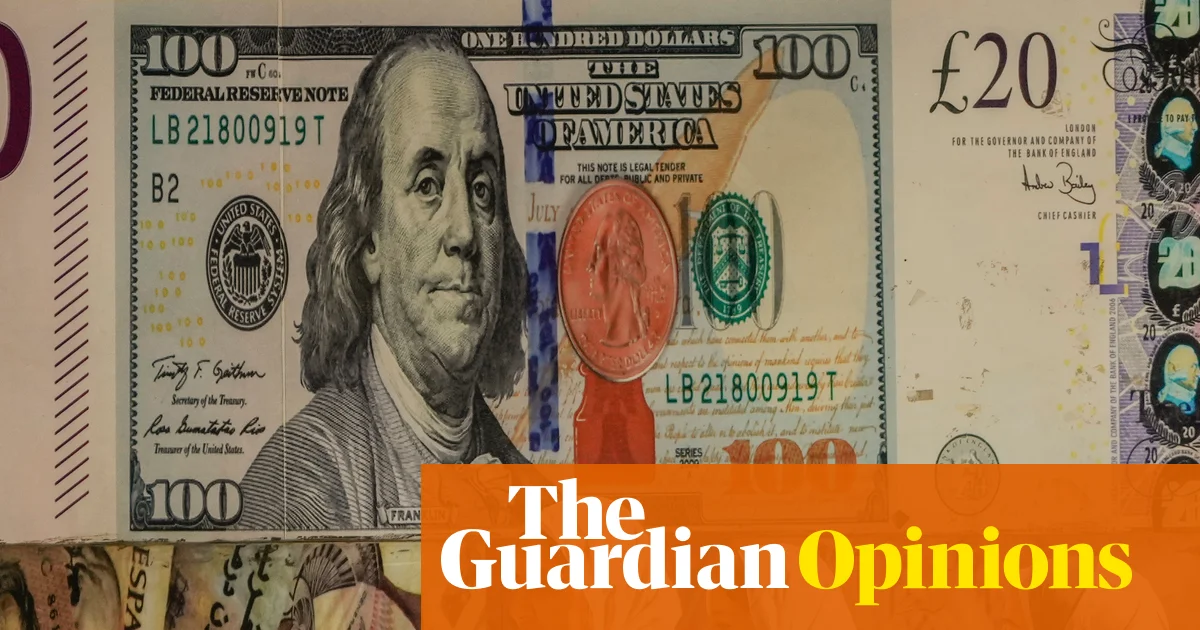
In the financial sphere, that is only likely to add weight to an incremental but historic shift away from the global dominance of the US currency and towards a more complex world that may be less to Washington’s liking.
The trade-weighted dollar, measured against a basket of global currencies, has lost 7% of its value over the past year despite strong US economic growth and soaring stock prices on Wall Street. That partly reflects the outlook for inflation, and therefore interest rates, but also perhaps a more nebulous sense that the US policy framework is not as solid and predictable as it may once have been.
As panellists concluded at a conference in London last week convened by the Centre for Inclusive Trade Policy, what appears likely is not that one currency will supplant the dollar, as the dollar abruptly replaced sterling after the second world war, but that a more complex, multipolar system will emerge.
International trade is still overwhelmingly denominated by the greenback, although the use of China’s renminbi is rising – a phenomenon actively facilitated by Beijing.
But when it comes to foreign currency reserves, global central banks have been quietly and gradually moving towards alternatives, with the share held in dollars slipping from 71% in 2001 to 57% by the final quarter of last year.
The seeds were sown long ago. The US Federal Reserve rode to the rescue of the global financial system at the height of the credit crisis in 2007-08 by opening up swap lines to handpicked countries, allowing central banks to exchange their own currency for desperately needed dollars.
The move was widely welcomed, in effect saving the offshore dollar system, but it laid bare the immense leverage the US has as a result of its currency being the lifeblood of the world economy.
Meanwhile, the increasing use of economic sanctions as a geopolitical weapon – including freezing offshore assets, and cutting off access to the Swift international payment system – has underlined the risks of what the US academics Henry Farrell and Abraham Newman have called “weaponised interdependence”.
That language was echoed by the Canadian prime minister, Mark Carney, in his speech at Davos, where he warned: “Great powers have begun using economic integration as weapons, tariffs as leverage, financial infrastructure as coercion, supply chains as vulnerabilities to be exploited.”
Washington’s growing willingness to use its financial dominance to strongarm rival countries has increased the clamour for alternatives to the greenback.
Another impetus towards de-dollarisation – or perhaps more rightly, an obstacle to it that has been removed – is the availability of technological solutions that make the infrastructure of settlement and exchange cheaper and faster. And new financial structures are being built, piece by piece. Experts point to the European Central Bank’s recent announcement that it will beef up its repo (repurchase agreement) arrangements – in effect a standing offer to lend euros to other central banks in times of crisis.
It’s just one cog in a complex system, but the ECB hopes that by making clear it will act as a lender of last resort in future financial emergencies, it can help to avoid the firefighting of the eurozone crisis and, in doing so, underpin the viability of the euro.
“China and Europe are thinking more about how to protect themselves,” says Alejandro Fiorito, of The Conference Board, a research body. “So they’re investing – because all of this is costly, politically and also economically – in digital euro, digital yuan, the repo lines. You can think about this as sort of self-insuring.”
The Brics countries – Brazil, China, India and Russia, plus a rash of more recent members – have long been committed to reducing the dominance of the dollar. While talk of a “Brics currency” remains theoretical, there is growing discussion of building financial linkages that bypass the US, including by establishing swap lines for use in emergencies, and making their respective central bank digital currencies interchangeable.
As Francisco Quintana, of Edinburgh Law School, puts it: “It’s a cumulative set of similar dynamics that are happening throughout the world, in a context in which it’s becoming more and more clear that it may not be the best thing to have such a huge dependence on the US, which is becoming less and less reliable.”
For the US, diminishing dollar dominance will have costs. Recent research has pointed to what economists at the Federal Reserve Bank of St Louis called a notable decline in what is known as the “convenience yield” of US treasuries.
That’s an estimate of how much cheaper it is for the US government to borrow, as a result of treasuries being the world’s favourite safe, liquid asset. The authors point to consistently high US deficits and rising debt as a driver of the deterioration. Waning trust in US institutions may be another.
Given the size of the US debt pile, on course to reach 130% of GDP in five years’ time, according to the International Monetary Fund, this could ultimately prove expensive.
For now, US Treasuries remain the asset many investors run to when times get scary. Yields fell on Friday as investors sought refuge from fears of a software share price crash.
But the process of de-dollarisation has been given fresh impetus by Trump’s chaotic regime, and governments around the world are quietly building alternatives. The heavily indebted US of a few years’ time, may not like what comes next.
