


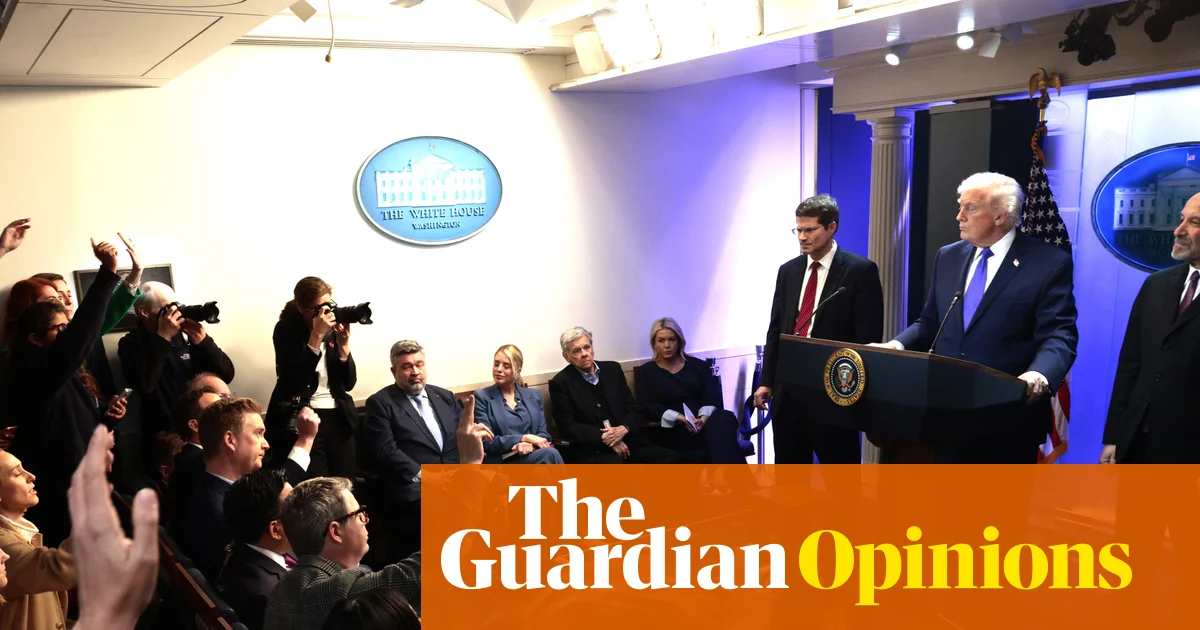
After two decades of deferring to executive authority and eroding anti-bribery laws, the supreme court has suddenly limited presidential power in a way that could make one ugly form of political influence a bit more difficult to pull off. Last week’s ruling did not merely strip one president of his executive power to unilaterally impose levies across broad swaths of the economy – it makes it harder for any president to transform tariffs from a broad economic policy into a personal political cudgel that muzzles criticism and enforces fealty.
“A Supreme Court otherwise inclined to endlessly expand Trump’s authority just restricted his go-to tool, ruling that U.S. presidents do not have the power to unilaterally deploy tariffs and dole out punishment and favor to specific companies and economic sectors, friends and family, and entire countries,” said Lori Wallach of Rethink Trade.
Donald Trump has been able to weaponize tariffs by citing a section of the International Emergency Economic Powers Act (IEEPA) that allows a president to “regulate … importation”. As long as tariffs were presumed to be a permissible form of “regulat[ing] … importation” under this law, Trump could assert the power to unilaterally impose whatever tariffs he wanted, at whatever product-by-product levels he chose, and with any exemptions he desired – all without explanation or explicit authorization from Congress.
Amid the administration’s grotesquerie of self-enrichment, Trump has spent his second term adjusting trade policy in bespoke ways that just so happen to reward political allies and donors. Some examples:
-
The Washington Post reported that Apple’s CEO, Tim Cook, dumped $1m into Trump’s inauguration, cultivated relationships with Trump officials, and “refrained from publicly criticizing the president or his policies on national television” – just before securing tariff exemptions for his company’s products.
-
ProPublica reported that the administration approved a tariff exemption for a thermoplastic made by a company “owned by a pair of brothers who have donated millions of dollars to Republican causes”.
Meanwhile, the Advanced Medical Technology Association gave Maga Inc $1m and has sought tariff exemptions for medical devices, and the energy conglomerate Continental Resources gave $1m and reportedly brokered meetings about tariff policy between fossil fuel industry and Trump trade officials. The president had also reportedly considered tariff exemptions for tech giants – after Google, Amazon and Microsoft funneled cash into Trump’s White House ballroom project.
This is all happening amid a bacchanal of influence-peddling among those seeking tariff exemptions – and the frenzy has enriched Washington lobbyists and law firms, particularly those with close ties to Trump and his inner circle.
And that’s just what we can see; it says nothing about a broader chilling effect among huge corporations self-censoring opposition to Trump’s authoritarianism as they beg him for tariff exemptions. As Politico reported, the largest and most powerful corporations “have largely stayed out of the legal fight challenging the levies, opting instead to quietly lobby against the policy for fear of angering a vindictive White House”.
That’s why the legal conflict over Trump’s tariffs has largely been left to smaller companies too under-resourced to try to buy their way into the palace and participate in Trump’s “kiss-the-ring” process.
‘Broad and uniform application’
But now comes the supreme court ruling, which rejected Trump’s claim that IEEPA gives him, as the court put it, “power to unilaterally impose unbounded tariffs and change them at will”. The court asserted that to do so, “the President must ‘point to clear congressional authorization’ to justify his extraordinary assertion of that power,” and ruled that the vague “regulate … importation” language in IEEPA does not rise to that level, especially since the constitution delegates tariff power exclusively to Congress.
The judicial decree doesn’t mean Trump cannot pursue tariffs. He still can – but he must now rely on other, more restrictive statutes already on the books. And those old laws at least somewhat impede the brazen preferencing of tariff exemptions for campaign donors.
Notice that when Trump responded to the high court’s decision by imposing new tariffs, they were time-limited, flat-rate and across-the-board – not newly tailored to benefit specific donors. That is because he now has to rely on Section 122 of the Trade Act of 1974, which permits such tariffs for only 150 days and requires him to apply them “consistently with the principle of nondiscriminatory treatment”.
That section requires any levies to “be of broad and uniform application with respect to product coverage” and states that “exceptions shall be limited to the unavailability of domestic supply at reasonable price, the necessary importation of raw materials, avoiding serious dislocations in the supply of imported goods, and other similar factors.”
It also says: “Neither the authorization of import restricting actions nor the determination of exceptions with respect to product coverage shall be made for the purpose of protecting individual domestic industries from import competition.”
And Section 122 only authorizes tariffs to address balance-of-payments deficits – a detail that may soon land Trump’s new tariffs back in court, because when defending his original levies, his justice department already told the court that such concerns were not at issue.
While the Trade Act’s caveats and qualifiers do grant Trump some wiggle room, the statute is far more limited than the IEEPA provisions Trump was previously trying to exploit. It’s the same story with many of the other laws providing presidents with tariff authority that Trump is now relegated to using. They don’t allow him to just wake up one day and raise or lower tariff rates on specific products or countries or hand out a bunch of exemptions to his donors without explanation. Most of the remaining tariff authorities he now must use require investigations, findings and more formal processes in order to impose tariffs.
To be sure, Trump has already proved those processes are not completely immune from political influence. During his first term, when he used a more restrictive tariff law to impose levies, academic researchers studying more than 7,000 tariff exemption requests discovered that firms that increased donations to Republicans saw a statistically significant boost in their likelihood of approval.
In his second term, Trump has aimed to vastly expand and institutionalize his bend-the-knee trade policy. Thankfully, the supreme court has for now rejected the most egregious part of that escalation.
In doing so, the justices underscored a broader warning – one that should be top of mind the next time they’re asked to strengthen the king’s authority: if power corrupts and absolute power corrupts absolutely, then concentrating ever more unilateral authority in the hands of a president increases the risk that democracy slides toward kleptocracy.
-
David Sirota is a Guardian US columnist and an award-winning investigative journalist. He is the founder of the Lever and the host of the podcast Master Plan. He served as Bernie Sanders’ presidential campaign speechwriter
