


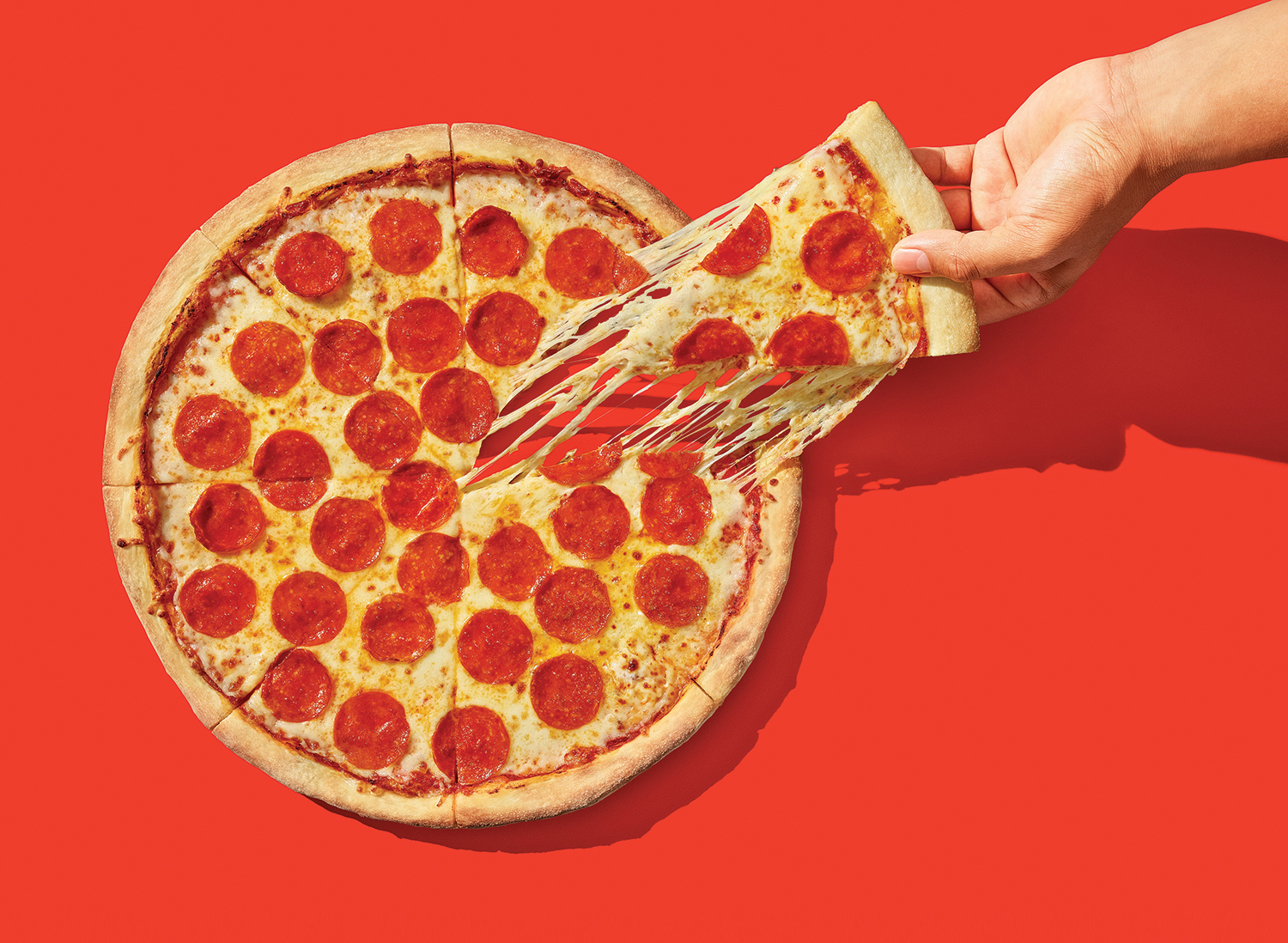
There are a lot of changes happening at Casey’s General Stores, but there is one thing that will remain the same: the cheese on the pizza.
“I would tell you this, we’re never going to change the cheese,” said Tom Brennan, Casey’s chief merchandising officer.
Don Lamberti opened his first Casey’s store in 1968 in Boone and before long, it seemed as if there was a Casey’s store in every small Iowa town. Today, the company’s headquarters are in Ankeny and it has more than 2,900 stores in 19 states. Roughly 700 of those stores were added within the past six years.
“When I started [in 2019], we had about 2,200 stores,” Brennan said. “In six years, we’ve scaled to over 2,900. We certainly grow organically and build new stores, but we also have made a number of acquisitions and most recently, Fikes Wholesale, when we bought the CEFCO brand. That’s the biggest deal Casey’s has done.”
With the Fikes acquisition, Casey’s added 198 stores to its portfolio.
“We will continue to scale the brand in that manner,” said Brennan, who oversees merchandising, marketing and supply chain operations for the company. “We are very dedicated to being able to integrate those acquisitions and get them into the fold as full-blown Casey’s that are executing at the level that we expect.”
A restaurant that sells gas
Casey’s first started making pizza in 1985 and continues to bake handmade pizzas at its stores.
Now it’s the fifth-largest pizza chain in the U.S., and the largest U.S.-owned convenience store chain; overall, it’s the third-largest convenience store chain, behind 7-Eleven and Circle K.
“You’ll hear people talk about, ‘That’s gas station pizza.’” Brennan said. “We say, ‘No, we’re a restaurant that happens to sell gas.’”
Three-quarters of the visits to Casey’s stores do not involve a gas purchase, he said. Customers buy food, beverages and other items, increasingly making Casey’s a regular meal provider, not just a quick stop-in option.
“Fortunately for all of us, the company made the decision to get into the pizza business 40 years ago, and really what further accelerated what was already a really strong brand, was the connection to food, the connection to being able to have a family dinner and this amazing pizza,” Brennan said. “I think that’s really what took us to the next level.”
Casey’s pizza will retain its quality despite the company’s growth, Brennan said. For now, the stores in the U.S. southeast region, for example, receive supplies from a third-party wholesaler.
“Our bread and butter is made-from-scratch, and that’s such a differentiator. It’s hard for me to imagine that we would fundamentally disrupt that or change that. But again, we also believe in continuous improvement,” he said. “We believe in evolving. That’s one of our values. We always want to evolve, and so we’ll see, but there are no plans that we’re working on in that regard.”
Casey’s menu has grown throughout the years to include sandwiches, chicken wings, side dishes like breadsticks, chicken tenders and macaroni and cheese, as well as breakfast items.
“Our guests give us a lot of positive feedback on our private-label quality,” said Katie Petru, Casey’s director of communications. “The number of SKUs is over 300 now; it’s chips, jerky, any kind of food.”
Brennan said private-label products are helping drive up consumer spending at the stores.
“Private label is very important to us, because it gives us a way to ensure that we can always be driving affordability and offering value to our guests,” he said.
Two-thirds of Casey’s stores are in towns of 20,000 people or fewer and about half are in towns of 5,000 or less.
“We are the center of those communities. We are there for those communities,” he said. “Our purpose is to make life better for communities and guests every day. I think we really live that.”
A focus on fundamentals
Casey’s attributes its success to several factors. The company’s values are known as Casey’s CARES, which stands for Commitment, Authenticity, Respect, Evolving and Service. The company refers to its business strategy as the Category of One, which means they strive to be community-centered with friendly employees and a food-first focus in stores.
To continue its success during its growth, the company focuses on the fundamentals, and controlling what it can.
“That applies to how we operate in stores, that applies to how our category managers go about managing their categories. That applies to how our marketing team approaches our media buys and everything like that,” he said. “It’s all about this groundedness in being fundamentally sound, because without being fundamentally sound, you can’t have that consistency, you can’t maintain it as you scale.”
Not every store among Casey’s recent acquisitions is baking and selling pizzas. Some of the stores are not outfitted with kitchens. Casey’s has created a brand concept for those called goodstop that maintain the feel of a Casey’s.
“Typically, when you’re buying a larger acquisition, you can’t cherry-pick sites and say, ‘Only these stores make sense for us to rebrand to Casey’s,’ and a lot of that often involves a remodel, where we have to invest additional capital, put our kitchen and equipment in so we can have the offer,” Brennan said.
There are more than 60 goodstop locations in operation.
“The reality of large acquisitions is there’s going to be a subset of stores where that investment doesn’t make sense, but we still want to run those stores, and we can still have a solid offer in those stores. Goodstop is a way for us to manage that,” Brennan said. “At goodstop … it will be a Casey’s store, and you’ll even have some Casey’s food. You just won’t have pizza. One of the most problematic things we can do is put the name Casey’s on the building and not have pizza. People who know the brand, that is their expectation.”
Casey’s in December announced strong second quarter results and revised its 2026 outlook upward, expecting earnings to increase 15% to 17%. The earnings report showed total revenue at $4.5 billion, a 14.1% increase from the same period a year ago. For its fiscal year that ended April 30, 2025, the company reported $15.94 billion in annual revenue.
“I feel very comfortable in our ability to compete at the highest level with the regional players in the industry,” Darren Rebelez, Casey’s chairman, president and CEO said during the earnings call. “They do well at what they do, and we do well at what we do. Those things aren’t always the same, but I think we can look market by market where we have that more intense competition, and we do very well there.”
Casey’s will unveil a new three-year strategic plan in June that will outline its business priorities for the next few years. Continued growth will be part of their strategy to reach their goal profitability.
“A key part of our strategy is growing units,” Brennan said, adding that the company needs to focus on both organic growth and acquisition growth.
“You’ll see us continue to grow, because it’s fundamental to our algorithm as a business, and there’s still so much opportunity. … There are 550 Casey’s in the state of Iowa and there are 3 million people,” Brennan said. “We’re now in Texas. Texas has 30 million people, and they’ve got a lot of small towns, so there’s a lot of Casey’s country in Texas.”
