

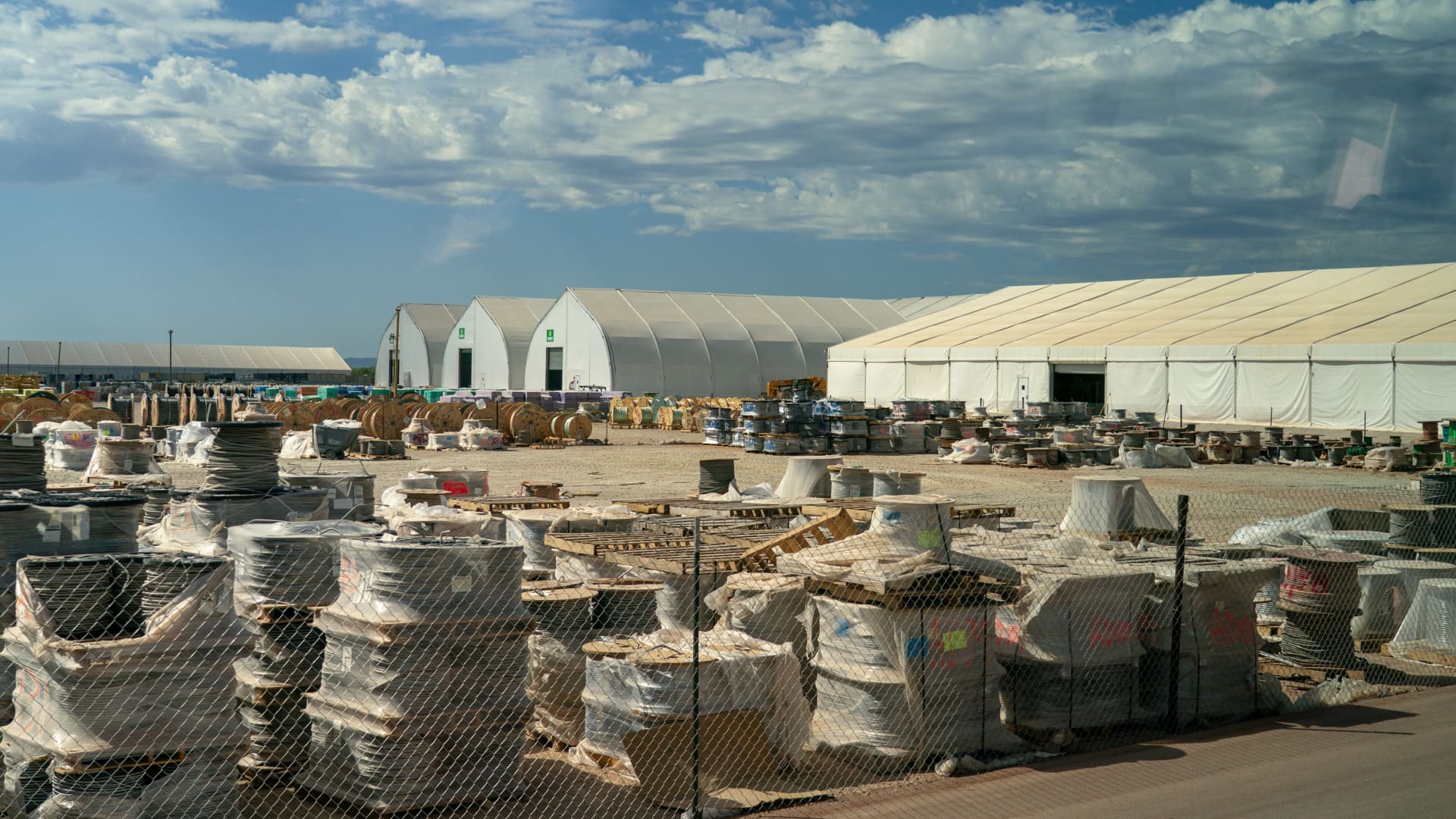
Spools of electrical wires outside a series of assembly tents during a media tour of the Stargate AI data center in Abilene, Texas, US, on Tuesday, Sept. 23, 2025. Stargate is a collaboration of OpenAI, Oracle and SoftBank, with promotional support from President Donald Trump, to build data centers and other infrastructure for artificial intelligence throughout the US.
Kyle Grillot | Bloomberg | Getty Images
With Treasury yields climbing this week to their highest levels since 2007, companies reliant on debt are poised to see their borrowing costs rise. That means the AI infrastructure buildout, which has already reached historic levels, is about to get even more expensive.
JPMorgan Chase estimated in June that $4.1 trillion in AI-related debt will be issued through 2030, as data center companies and others tied to the artificial intelligence boom race to build up capacity to meet what many industry experts view as insatiable demand for AI services.
As borrowers go back to the market, they’re now looking at a 10-year Treasury yield that sits near 5.17%, up about 1 percentage point since the start of the year, meaning companies issuing debt are going to have to offer more attractive rates of return to lure investors.
The market isn’t in panic mode, at least not yet. Shares of debt-heavy neocloud CoreWeave have held up fine, rising almost 8% this week, while Oracle, which has counted on the debt market for its AI expansion, has had a tougher time, falling 7% for the week and about 30% this year.
Stock Chart IconStock chart icon
CoreWeave vs. Oracle this week
Meanwhile, Japan’s SoftBank, a principal provider of capital for AI projects, raised $11.1 billion in a junk-bond sale this week, with yields as high as 9.75% for the 7-year tranche.
“They basically are price insensitive to that raise, which means they’re price takers,” said Mark Malek, chief investment officer at Siebert Financial, in an interview. “In my view, a lot of these companies need to be price insensitive. They need to get as much capital as possible to compete.”
At the center of the AI craze are leading model developers OpenAI and Anthropic, which are each valued at close to $1 trillion in the private market. To provide the infrastructure needed for their advanced models, as well as models and services from a host of other companies, tech’s hyperscalers — Amazon, Google, Meta and Microsoft — have committed to hundreds of billions of dollars this year in capital expenditures, with an expected increase coming in 2027.
While a healthy dose of that investment is being funded through debt raises, those tech giants all have investment grade credit ratings, providing them with cheaper access to capital. But for the rest of the pack, bigger challenges lie ahead, according to some market participants.
Warning signs?
A senior private credit investor, who asked to remain unnamed in order to speak candidly on the matter, told CNBC that, moving forward, neocloud deals will be more difficult to finance, because the companies have less cushion to absorb the costs.
Riley Thompson, a vice president at Mitsubishi HC Capital America said in an interview that lenders are getting pickier about the projects they’re willing to fund even if the borrower agrees to pay a higher rate.
“Instead of a roster of 50 neoclouds, there’s probably 20 that the market’s truly interested in,” Thompson said.
CoreWeave, which went public last year, warns about rising rates in its SEC filings. In its latest quarterly filing, the company said that, as of June, every 100-basis point (1 percentage point) increase in rates could result in a $30 million jump in its interest expense, based on the balance of its outstanding floating rate debt.
An early warning sign may have landed this week, when Oracle’s stock slid following a Bloomberg report that the company sent a “force majeure” notice tied to its New Mexico data center project to protect itself from higher expenses. The company is looking to delay payment on the campus, dubbed Project Jupiter, if it fails to come online as expected in 2028, the report said. Oracle said the project “remains on our planned schedule.”
Rising interest rates aren’t the only matter at hand. Prior to this week’s spike in yields, the CEOs of Anthropic and OpenAI had started urging a slowdown in the pace of AI development after industry researchers went public with concerns that advanced models risk spinning out of human control.
At the same time, a nationwide backlash against AI data centers has emerged as a major issue heading into November’s midterm elections, with 69% of respondents to a recent NBC News Decision Desk Poll, powered by SurveyMonkey, saying they oppose the construction of such facilities in their local area. On Monday, Texas Republican Gov. Greg Abbott, who’s in the midst of a tight race for reelection, ordered a temporary halt to all data center-related environmental permits following a moratorium on grid approvals last month.
Still, demand for AI services is exploding. The latest example is Meta’s Muse personal assistant app, which has rocketed in popularity since its launch earlier in September. Muse clocked more than 2.5 million global downloads in its first two weeks, passing ChatGPT at the top of Apple’s App Store, and Evercore’s Mark Mahaney told CNBC this week that it could reach 100 million users within six to 12 months.
Mark Zuckerberg, chief executive officer of Meta Platforms Inc., reveals the Muse Charm device during the Meta Connect event in Menlo Park, California, US, on Wednesday, Sept. 23, 2026.
Minh Connors | Bloomberg | Getty Images
Andrew Giudici, global head of corporate, project, and infrastructure finance at credit rating agency KBRA, said that even as rising rates may affect future deals, he doesn’t see a major impact on borrower demand.
“In a normal environment, people might take a step back and pause a bit,” Giudici said. “But I don’t think that’s going to happen here. I think you’re going to continue to see relatively large issuance.”
Haim Zaltzman, vice chair of Latham & Watkins’ emerging companies and growth practice, said there’s no doubt that as costs rise, “somebody will have to absorb it.”
“But absorbing it in that kind of demand structure, where the demand is so great, is a lot easier,” said Zaltzman, who works on AI infrastructure financing.
The equation is even simpler for Bernie Margulies, CEO of American Compute, which advises on risk management for GPU financing. He said borrowers are eager to secure financing even at higher costs, especially if they have commitments with OpenAI and Anthropic, which have been signing contracts to secure compute capacity years into the future.
“If you have a deal with Anthropic, will 50 basis points really stop you?” Margulies said.
WATCH: Meta’s Muse will likely soar to 100 million users
