


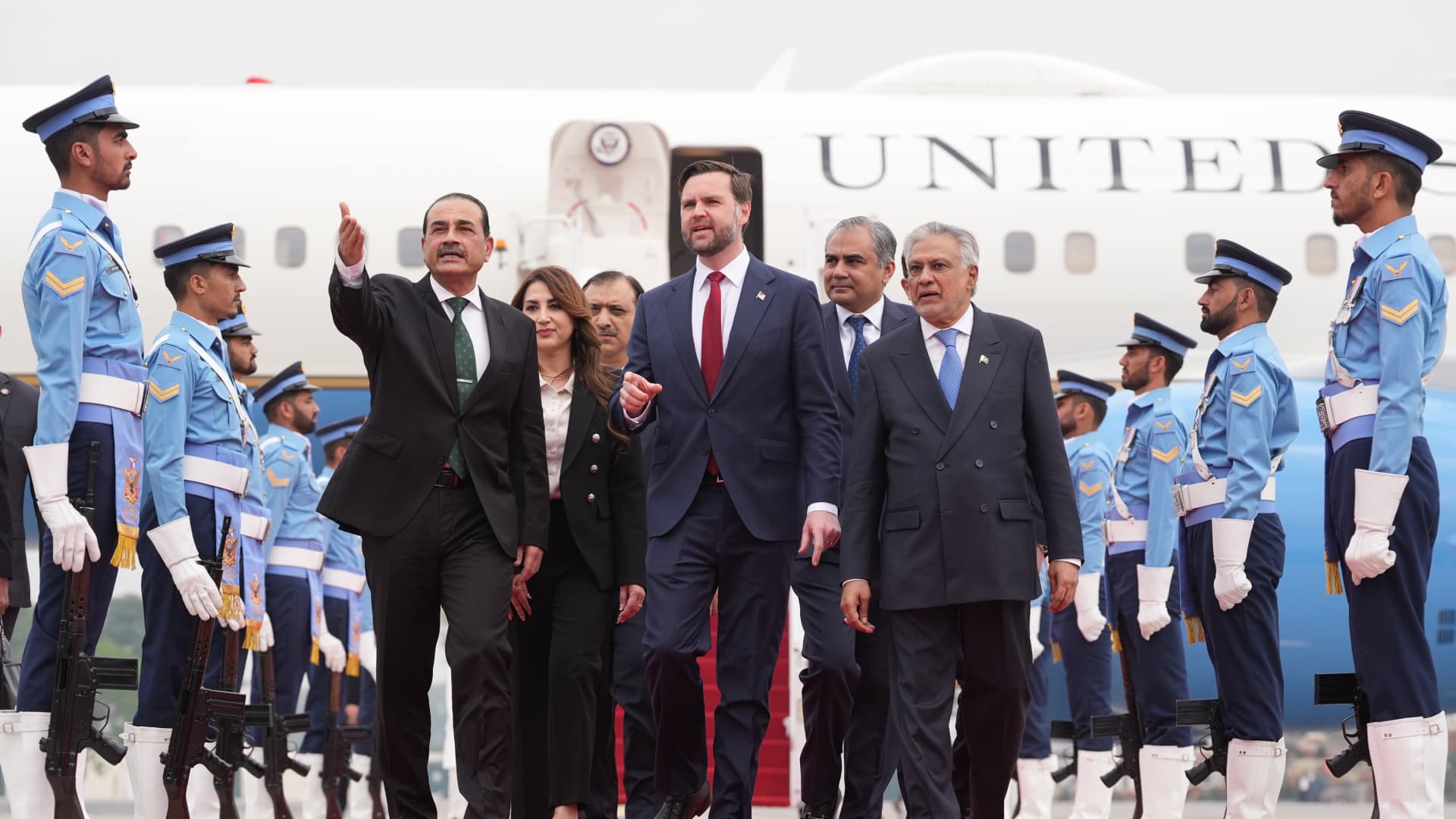
ISLAMABAD, PAKISTAN – APRIL 11: U.S. Vice President JD Vance (C) walks with Pakistan’s Chief of Defence Forces and Chief of Army Staff Field Marshall Asim Munir (L), and Pakistani Deputy Prime Minister and Foreign Minister Mohammad Ishaq Dar after arriving for talks with Iranian officials on April 11, 2026 at Islamabad, Pakistan. (Photo by Jacquelyn Martin – Pool/Getty Images)
Pool | Getty Images News | Getty Images
The first round of peace talks between the United States and Iran has reportedly ended on Saturday, with no resolution, as the war entered its seventh week.
An Iranian delegate source familiar with the negotiations told MS NOW that the first phase of talks had ended and that the talks were expected to continue on Sunday. The source said talks got tense in the last few hours, but said that they are in a “good position.”
The talks took place as two American warships transited through the Strait of Hormuz for the first time since the start of the conflict. The U.S. Central Command said the warships were taking part in a mission to clear the waterway of sea mines put in place by Iran.
The tri-lateral negotiations seek to cement a two-week ceasefire that began Tuesday but which has come under strain as Iran continues to block most shipping traffic through the Strait of Hormuz, the world’s most critical chokepoint for oil and gas supplies. Tehran also reiterated a list of preconditions for the talks.
The U.S. delegation, led by Vice President JD Vance, and the Iranian one, led by Parliament Speaker Mohammad Bagher Qalibaf, discussed with Pakistan how to advance the ceasefire already threatened by deep disagreements and Israel’s continued attacks against the Iranian-backed Hezbollah in Lebanon, whose health ministry said the death toll has surpassed 2,000.
Since the Islamic Revolution in Iran in 1979, the most direct U.S. contact had been in 2013 when then-President Barack Obama called newly elected President Hassan Rouhani to discuss Iran’s nuclear program. The most recent highest-level meetings were between Secretary of State John Kerry and counterpart Mohammad Javad Zarif during negotiations over the program.
Now talks feature Vance, a reluctant defender of the war who has little diplomatic experience and warned Iran not to “try and play us,” and Qalibaf, a former commander with Iran’s powerful Revolutionary Guard who has issued some of Iran’s most fiery statements since fighting began.
U.S. destroyers transit the Strait of Hormuz
The meeting comes amid heightened tensions over conflicting reports concerning the Strait of Hormuz.
U.S. Central Command said on Saturday that forces began setting conditions for clearing mines in the strait, as two U.S. Navy guided-missile destroyers conducted operations. The USS Frank E. Peterson and the USS Michael Murphy transited the strait and operated in the Arabian Gulf as part of a broader mission to clear sea mines previously laid by Iran’s Islamic Revolutionary Guards Corps, Defense Secretary Pete Hegseth said in a post on X.
“Today, we began the process of establishing a new passage and we will share this safe pathway with the maritime industry soon to encourage the free flow of commerce,” Adm. Brad Cooper, commander of CENTCOM, said in a statement.
“We’re sweeping the strait. Whether we make a deal or not makes no difference to me,” U.S. President Donald Trump told journalists as high-stakes talks continued into the night and the time approached 2 a.m. in Pakistan.
Iran’s state media, however, earlier said Iran forced a U.S. military ship that was attempting to cross the strait to turn around. MS Now later reported that commercial maritime traffic systems showing the USS Michael Murphy crossing the Strait of Hormuz into the Persian Gulf weren’t reliable.
Separately, a senior Iranian source told Reuters the U.S. had agreed to release frozen assets held in Qatar and other foreign banks, but a U.S. official immediately denied the report.
Iranian preconditions
But question marks hang over the ceasefire and the ultimate outcome of the talks.
Iran’s Tasnim news agency said Tehran has presented negotiators with four “non-negotiable conditions” to mediators in Islamabad.
They include: “[F]ull sovereignty over the Strait of Hormuz, complete war reparations by the aggressor, unconditional release of blocked assets, and a durable ceasefire across the entire West-Asia Region,” Tasnim said on its X account.
Ghalibaf warned Friday that the scheduled negotiations to end the war with the U.S. cannot begin unless Israel halts attacks on Lebanon and unless the U.S. releases Tehran’s frozen assets.
Ghalibaf issued the ultimatum after the American delegation led by Vance left for Islamabad to attend the talks.
“Two of the measures mutually agreed upon between the parties have yet to be implemented: a ceasefire in Lebanon and the release of Iran’s blocked assets prior to the commencement of negotiations,” Ghalibaf said in an X post.
“These two matters must be fulfilled before negotiations begin,” he wrote.
Tankers exit the Gulf via the strait
Three supertankers passed through the Strait of Hormuz on Saturday, shipping data showed, marking what appeared to be the first vessels to exit the Gulf since the U.S.-Iran ceasefire deal.
Tehran’s blockade of the strait, a chokepoint for about 20% of global oil and liquefied natural gas shipments, since the start of the Iran war at the end of February, has disrupted global energy supplies and sent oil prices soaring.
The Liberia-flagged Very Large Crude Carrier (VLCC) Serifos and China-flagged VLCCs Cospearl Lake and He Rong Hai, entered and exited the “Hormuz Passage trial anchorage” that bypasses Iran’s Larak Island on Saturday, LSEG data showed.
Each vessel is capable of carrying 2 million barrels of oil.
Serifos, carrying crude loaded from Saudi Arabia and the United Arab Emirates in early March, is expected to arrive at Malaysia’s Malacca port on April 21, data from LSEG and analytics firm Kpler showed.
Cospearl Lake is laden with Iraqi oil and He Rong Hai is carrying Saudi crude, the same data showed.
Both VLCCs are chartered by Unipec, the trading arm of Chinese energy giant Sinopec, according to the data.
Trump’s frustration with Iran
Trump has expressed frustration with Iran continuing to block most shipping traffic through the Strait of Hormuz.
In an announcement Tuesday evening, Trump said that the U.S. would agree to a two-week suspension of hostilities subject to Iran agreeing to a complete and immediate reopening of the Strait of Hormuz.
But since then, vessel traffic through the strait remains nearly as tightly throttled as it has been since the war began on Feb. 28.
In a Truth Social post on Thursday evening, Trump fumed, “There are reports that Iran is charging fees to tankers going through the Hormuz Strait — They better not be and, if they are, they better stop now!”
Iran “is doing a very poor job, dishonorable some would say, of allowing Oil to go through the Strait of Hormuz,” the president wrote in a follow-up post. “That is not the agreement we have!”
Israel and Lebanon will have direct negotiations
Negotiations between Israel and Lebanon are expected to begin Tuesday in Washington, Lebanese President Joseph Aoun’s office said Friday, after Israel’s surprise announcement authorizing talks despite the countries’ lack of official relations.
But thousands in Lebanon protested the planned negotiations, and Prime Minister Nawaf Salam said he had postponed a planned trip to Washington “in light of the current internal circumstances.” It was not immediately clear what that meant for the talks.
Read more CNBC politics coverage
Israel wants the Lebanese government to assume responsibility for disarming Hezbollah, much like was envisaged in a November 2024 ceasefire. But it is unclear whether Lebanon’s army can confiscate weapons from the militant group, which has survived efforts to curb its strength for decades.
Israel’s insistence that the ceasefire in Iran does not include a pause in its fighting with Hezbollah has threatened to sink the deal. The militant group joined the war in support of Iran in the opening days. Israel followed up with airstrikes and a ground invasion.
The day the Iran ceasefire deal was announced, Israel pounded Beirut with airstrikes, killing more than 300 people in the deadliest day in Lebanon since the war began, according to the country’s Health Ministry.
Pope Leo blasts ‘delusion of omnipotence’ fueling war
In his strongest words yet, Pope Leo XIV denounced the “delusion of omnipotence” that is fueling the U.S.-Israel war in Iran and demanded that political leaders stop and negotiate peace.
Leo presided over an evening prayer service in St. Peter’s Basilica on the same day the United States and Iran began face-to-face negotiations in Pakistan and as a fragile ceasefire held.
History’s first U.S.-born pope didn’t mention the U.S. or Trump in his prayer, which was planned before the talks were announced. But Leo’s tone and message appeared directed at Trump and U.S. officials, who have boasted of U.S. military superiority and justified the war in religious terms.
“Enough of the idolatry of self and money!” Leo said. “Enough of the display of power! Enough of war!”
In the basilica pews was the archbishop of Tehran, Belgian Cardinal Dominique Joseph Mathieu. The U.S. was represented in the diplomatic corps by its deputy chief of mission, Laura Hochla, the U.S. Embassy said.
— Reuters and the Associated Press contributed to this report
Choose CNBC as your preferred source on Google and never miss a moment from the most trusted name in business news.
