


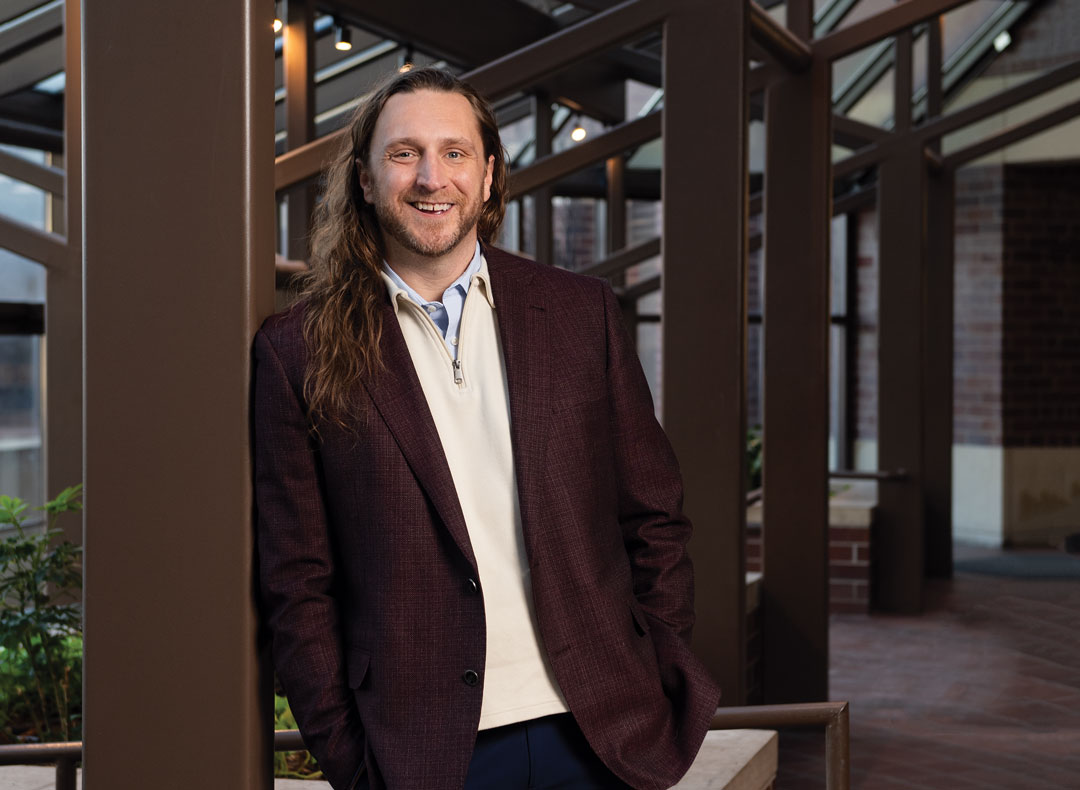
Zachary Rus is determined to be the adult he needed when he was a kid.
Rus grew up in Northwest Iowa in a town of around 700 people. His family experienced the effects of poverty and mental health issues. He knew he was gay from a young age and didn’t have anyone to help him understand what that meant.
He feels called to ensure the generations that come after him don’t have to experience the hardship he did.
“I get a lot of people asking, ‘Why did you move back? How do you stay there?’” Rus said of living in Iowa. “Because I didn’t have anyone growing up here. The thought of leaving and not fighting the good fight — I don’t think I could do it.”
He lived in Chicago for a few years, but ultimately moved back to Iowa in 2018 to be closer to family. A moment of generosity from his college years continues to inspire him to help others in his home state.
“As a first-generation college student, I was there because of other people’s generosity and that’s what really drove where I went after school,” Rus said. “At graduation, I had a bill that had to be paid or I couldn’t [go to] commencement. I didn’t think I was going to be able to graduate. When I walked in that day, there was a gift on my chair and a card that just said, ‘Congratulations.’ They had paid the bill for me. Someone being able to do that for me really started me thinking, ‘Gosh, I want to do this for other people.’”
Rus was named executive director of Iowa Safe Schools in July 2025. The nonprofit provides support, victim services, resources and events for LGBTQ+ and allied youth in Iowa. He was recognized as a Business Record Forty Under 40 in 2025. He previously served as the engagement director for Ellipsis, a care provider supporting kids and families in need.
The Business Record sat down with Rus to learn more about him and his role.
This interview has been lightly edited and condensed for clarity.
Through working at Ellipsis and now Iowa Safe Schools, you obviously have a passion for helping children who have faced barriers or hardship in their lives. Where does your passion for this work come from?
I heard people say gay was wrong, and I spent so much time trying to pray that away. When you spend your entire life trying to change something that’s not meant to be changed, even if your family is supportive, it’s so hard to try to fit in and prove yourself because someone told you you were inherently wrong when there was nothing wrong with you to begin with. It really feeds into my mission in life and why I want to be here and take care of these kids and say, ‘No, you do have a future.’ Seventy percent to 80% of our kids don’t see themselves living in Iowa after graduation. But while you’re here, I want you to be safe and in a community that’s supportive of you.
I want kids to grow up and just be able to be kids. They’re not worrying about putting a meal on the table or getting a job early or figuring all those things out. I wish I could have grown up in a place where I didn’t have to worry about the heat being on and things like that. Ellipsis was so huge for me because the kids are dealing with so much, and none of it’s their fault. I always say there are no bad kids, there are kids that haven’t had access to support and services and adults that care about them. If we’re really Iowa nice, how are we letting this population of homeless kids in Des Moines go? That’s not Iowa nice, that’s Iowa passive. We’re such a homogenous state that we assume everyone has the same lived experience, and we just don’t.
At the Forty Under 40 ceremony last year, you said that there are no bad kids, only bad circumstances. I shared with you that that concept has been stuck in my head and changed how I interact with kids in my own life. Can you explain what you mean by that and how that concept influences your work?
Everyone sees the behaviors of some kids, and they never pause. Instead of assuming why a kid is doing something, ask the question ‘What happened to you?’ They aren’t a bad kid, they just need support and someone to care about them and show that care. If we really care about the state we live in, how are we not taking care of the next generation of our kids? Especially at Ellipsis. We’re taking care of the kids, but we can’t send them back to a home where the parents aren’t getting support. Those parents, at one point, were kids that didn’t have access to the support they needed. Kids deserve support. Humans deserve support and access to services. As a state, we have a ton of services, but if you don’t have gas to get there, you’re not getting the service. If you don’t have money to pay your cellphone bill, you can’t make the appointment. If we’re taking SNAP benefits away, that’s more money that’s going towards grocery bills and not others. When did we get away from caring about human beings and keeping them safe? I want kids to grow up in a space and a place where they can be themselves, where they can see themselves finding success. Because when all you’re worried about is a meal on the table or not getting abused, success looks like survival.
What was it like to transition into leading this nonprofit that supports LGBTQ+ youth at a time when so much was changing in the nonprofit and DEI spaces?
It’s been really interesting. During my time at Ellipsis, seeing the system and how it’s set up and the work it could use, there are waiting lists for stuff. When things are underfunded in the past, and these problems grow and compound, then we have a bigger issue on our hands that we’re trying to fix. We’re not forcing anyone to agree, but I’m asking you to see people as human beings, and that’s what’s been the biggest transition for me.
One of the other big things coming into this leadership position is that it’s not just the work that we do for the kids, it’s who we are as an organization. When your mere existence is constantly politicized, it’s exhausting. One of my biggest focuses is making sure that while the staff do really great, really hard work that we could do all day, we’re not going to do our best work burnt out. I always tell everyone, burnout is not a badge of honor. There is a lot of work to do.
In general, it’s having the conversations and meeting people where they’re at more because it doesn’t work to tell people they’re wrong. When it’s your life and your job, it’s a little different. It hits a little closer to home.
I imagine your work can sometimes get a little heavy. How do you stay connected with your joy?
Before my mom passed away, we had a few days with her, and her biggest thing was reminding us every day to find joy in whatever we do. For me, that’s surrounding myself with people who are thoughtful, have critical thinking skills, who don’t accept things at face value and are open to learning.
I play pickleball. I love to have a good ‘crafternoon.’ I like supporting community events. I surround myself with good people. I don’t shy away from difficult conversations. For me, this is who I am. There are people out there who see the value in the work that we do. I told [Chris Conetzkey] at the Book of Lists that what I’m looking forward to this year is keeping kids alive and giving the hope that there are people out there that care about them. We’re building a better Iowa for them.
Is there an adult that made a significant positive impact on you when you were a kid that helped you feel safe and seen?
At Simpson, I had a professor hold me after class one day and say, ‘Hey, I have a meeting scheduled for us.’ It was after an incident of homophobia on campus and she said, ‘We’re going to the president’s office.’ She introduced me and explained what happened and asked what he was going to do. The president starts talking about all the benefits and things for faculty and staff. My professor stops him and goes, ‘Thank you so much for sharing all that, but Zach is a student here and you haven’t addressed any of the things that are happening to Zach.’ The president starts going down the same path of his talking points and my professor grabs me by the wrists and goes, ‘And we are done here, because he does not get what we’re asking for or the impact of what happened to you.’ She went on to do a bunch of stuff on campus to make it more welcoming and inviting. Those people in my life really drove me to want to make sure that everyone else felt that way after, too.
And then my high school guidance counselor. She sat me down once, and I was a ‘try hard’ in high school. I didn’t get homecoming court, and I was so disappointed. She said, ‘Zach, if you continue to care about people the way you do, you will never lose a thing like this again.’ Now that I’m grown, I see the importance of those things is not getting the award, but it’s the visibility and having young LGBTQ+ kids see someone that they can see themselves being and they can see themselves growing up in a place like this. They all allowed me to be me, and I think that’s what helped me find success.
At a glance
Hometown: Sutherland, Iowa
Education: Bachelor’s degree in corporate communications, Simpson College
Activities: Pickleball, volleyball, spending time with loved ones
Contact: zach@iowasafeschools.org
