


Trump to talk with Iranians, The Atlantic reports
U.S. President Donald Trump arrives at Joint Base Andrews in Maryland, U.S., February 19, 2026.
Kevin Lamarque | Reuters
Trump will speak with Iranian leadership one day after launching a strike on the country that killed its leader, Ayatollah Ali Khamenei.
“They want to talk, and I have agreed to talk, so I will be talking to them,” Trump told The Atlantic on Sunday.
The U.S.-Israeli joint assault on Iran comes after Washington and Tehran were engaged in talks for a new nuclear agreement. Trump lamented to The Atlantic that Iran did not speak to him earlier.
“They should have done it sooner. They should have given what was very practical and easy to do sooner. They waited too long,” Trump said.
Trump declined to specify to the magazine when he would be speaking to Iranian representatives. However, he noted that many involved in the previous talks have since been killed.
“Most of those people are gone. Some of the people we were dealing with are gone, because that was a big— that was a big hit,” the president said.
Iran has since launched a counterattack on the U.S. and its regional allies. U.S. Central Command announced Sunday that three U.S. service members were killed in the operation.
— Garrett Downs
U.S. uses Anthropic’s Claude to support Iran strikes, Axios says
The U.S. military used Anthropic’s Claude artificial intelligence technology to support the strikes on Iran on Saturday, according to a report by Axios, which cited unidentified sources familiar with the Pentagon’s operations.
Trump on Friday had ordered U.S. government agencies to “immediately cease” using Anthropic’s services, after the AI startup refused to comply with demands about the use of its technology. He wrote on social media that there would be a six-month phase-out period.
Shortly afterward, Defense Secretary Pete Hegseth wrote on X that he was ordering the Pentagon to designate Anthropic a “Supply-Chain Risk to National Security.” Anthropic, which signed a $200 million contract with the Pentagon in July, said it would fight such a designation in court.
Anthropic wanted assurances that its AI models would not be used for fully autonomous weapons or mass domestic surveillance of Americans. The Defense Department resisted that request.
The U.S. military’s use of Claude during Operation Epic Fury in Iran follows its leveraging of the technology to capture Venezuelan president Nicolás Maduro in January, which prompted the initial feud between Anthropic and the U.S. government, according to the Axios report.
OpenAI struck a deal with the Pentagon just hours after Trump blacklisted rival Anthropic.
— Greg Iacurci
At least three tankers damaged in Gulf, report says. Maersk pauses, reroutes sailings
Smoke billows from an oil tanker under U.S. sanctions, that was hit off Oman’s Musandam peninsula, in this screen grab from a video obtained by REUTERS on March 1, 2026.
Reuters
At least three tankers in the Gulf have been damaged since the U.S. and Israel began trading strikes with Iran, Reuters reported Sunday. It is unclear whether the damage to the tankers was done deliberately or accidently.
Shipping giant Maersk said it has paused Trans-Suez sailings through the Bab el-Mandeb Strait for the moment. Instead, some sailings will be rerouted around the Cape of Good Hope. All vessel crossings in the Strait of Hormuz are also suspended, it said.
“The safety of our crews, vessels and customers’ cargo remains our key priority and we will continue to monitor the situation closely and take all needed actions,” the company said in a statement. “We remain committed to minimising the impact on our customers’ supply chains and will continue to keep them updated on the situation.”
Reuters reported that shipping sources told them that more than 200 vessels including oil and liquefied gas have dropped anchor in the Strait of Hormuz and surrounding area. Positioned between Oman and Iran, the narrow channel is a potential chokepoint for global energy trade.
More than 14 million barrels per day traveled through the Strait last year, or a third of the world’s total seaborne crude exports, according to data from energy consulting firm Kpler. Only a fraction of that can be rerouted.
—Christina Cheddar Berk
Trump to CNBC: U.S. ‘ahead of schedule’ in Iran
US President Donald Trump delivers remarks about energy at the Port of Corpus Christi in Texas, on Feb. 27, 2026.
Mandel Ngan | AFP | Getty Images
President Donald Trump told CNBC’s Joe Kernen on Sunday that the U.S. operation in Iran is “moving along very well, very well — ahead of schedule.”
“It’s a very violent regime, one of the most violent regimes in history,” Trump said, reached by phone. “We’re doing our job not just for us but for the world. And everything is ahead of schedule.”
Trump on Saturday began a joint strike on Iran that killed the country’s leader, Ayatollah Ali Khamenei. Iran has since launched a counterattack. He has overseen the assault from his Mar-a-Lago residence in Palm Beach, Florida.
Trump addressed a potential off-ramp to end the conflict, which he said depends on many variables. But the president said things are moving in a positive direction.
“Things are evolving in a very positive way right now, a very positive way,” he said.
— Garrett Downs
3 U.S. service members killed during Iran operation
Three U.S. soldiers have been killed in the U.S.-Israeli military operation in Iran that killed the country’s leader on Saturday, according to the U.S. Central Command.
“As of 9:30 am ET, March 1, three U.S. service members have been killed in action and five are seriously wounded as part of Operation Epic Fury,” U.S. Central Command said in a post on X. “Several others sustained minor shrapnel injuries and concussions — and are in the process of being returned to duty.”
The deaths are the first known U.S. casualties of the combat, which began early Saturday and has prompted fierce retaliation from Tehran. The identities of the soldiers have not yet been released, pending notification of their families.
Trump warned there could be casualties as a result of the operation on Saturday.
“That often happens in war. But we are doing this not for now, we are doing this for the future and it is a noble mission,” Trump said.
—Garrett Downs
Warner says he’s seen ‘no intelligence’ Iran planned preemptive strike
Senator Mark Warner, a Democrat from Virginia, speaks to members of the media following a Gang of Eight briefing on Capitol Hill in Washington, DC, US, on Tuesday, Feb. 24, 2026.
Graeme Sloane | Bloomberg | Getty Images
Sen. Mark Warner, (D-Va.), the top Democrat on the Senate Intelligence Committee, said on Sunday he’s seen “no intelligence” to suggest that Iran was planning a preemptive strike on the U.S., as the Trump administration has claimed.
“I saw no intelligence that Iran was on the verge of launching any kind of preemptive strike against the United States of America,” Warner said on CNN’s “State of the Union.”
“None,” Warner, who has access to highly classified information in his role, added.
Warner’s statement directly contradicts the Trump administration’s justification for the conflict. The administration said Saturday that the strikes came as Iran was readying to hit U.S. interests.
“We had analysis that basically told us, if we sat back and waited to get hit first, the amount of casualties and damage would be substantially higher than if we acted in a preemptive defensive way to prevent those launches from occurring, and that is the focus of the campaign right now,” a senior Trump administration official told reporters Saturday, according to MS Now.
Republicans have largely defended the president’s strike.
Sen. Tom Cotton, (R-Ark.), Warner’s counterpart, said on CNN Sunday that “President Trump is right that it is absolutely vital and necessary now to address that threat before it fully materializes in the near future.”
— Garrett Downs
U.S. Embassy ‘not in a position’ to evacuate or assist U.S. nationals leaving Israel
An Israeli flag is displayed in front of a building near a road sign for the US embassy in Jerusalem on September 27, 2023.
Ahmad Gharabli | Afp | Getty Images
The U.S. Embassy in Jerusalem said it is “not in a position at this time to evacuate or directly assist Americans” who are trying to leave Israel.
Ben Gurion Airport, Israel’s main international airport, remains closed to all commercial and charter flights, the Embassy said in a security alert.
It directed all U.S. government employees and their family members to continue to shelter in place in and near their residences until further notice.
“The U.S. Embassy reminds U.S. citizens of the continued need for caution and increased personal security awareness — including knowing the location of the nearest shelter in the event of a red alert as security incidents, such as mortar, rocket, and missile fire, and unmanned aircraft system (UAS) intrusions, often take place without any warning,” the alert said. “The security environment is complex and can change quickly.”
—Greg Iacurci
What a jump in oil prices means for U.S. consumers
Anna McConnell pumps gas into her vehicle on Oct. 24, 2025 in Miami, Florida.
Joe Raedle | Getty Images
Oil markets are on edge ahead of the start of trading at 6 p.m. ET, and any jump in prices could lead to higher prices at the pump for U.S. consumers.
Andy Lipow, president of Lipow Oil Associates, expects crude prices to rise between $3 and $5 a barrel this evening, which translates to an 8 to 12 cent increase per gallon of gasoline. But he said the impact won’t be felt immediately — it will take between 7 and 10 days to show up at the pump.
The national average for a gallon of regular gasoline is $2.98, according to AAA, down from $3.10 one year ago.
Lipow cautioned that a complete closure of the Strait of Hormuz could drive oil prices up by as much as $20 per barrel, translating to a 50-cent increase in the price per gallon of gasoline. Under such a scenario, the U.S., the European Union and others would likely tap their strategic petroleum reserves to counter supply disruptions, he said.
—Pippa Stevens
Another 1,500 Middle East flights canceled due to strikes
A person points at a page on the Flightradar 24 website thats shows civilian flights avoiding Iranian and Iraqi sky, in Paris on March 1, 2026.
Anna Kurth | Afp | Getty Images
Another 1,579 flights in and out of major airports in the Middle East were canceled on Sunday, Cirium said. Dubai International Airport, which reported damage from an incident on Saturday, was the most affected, with 747 flights, or 70% of its flights, canceled, Cirium said.
At least 70% of flights were also canceled in Israel and Qatar.
Airspace closures in the region grounded hundreds of flights in the region.
—Leslie Josephs
OPEC+ agrees to raise oil production by 206,000 barrels per day
An installation depicting barrel of oil with the logo of Organization of the Petroleum Exporting Countries (OPEC) is seen during the COP29 United Nations climate change conference in Baku, Azerbaijan November 19, 2024.
Maxim Shemetov | Reuters
OPEC+ has agreed to raise oil production by a modest 206,000 barrels per day, the group said in a statement Sunday.
“In view of a steady global economic outlook and current healthy market fundamentals, as reflected in the low oil inventories, the eight participating countries decided to resume the unwinding of the 1.65 million barrels per day of additional voluntary adjustments announced in April 2023 and agreed on a production adjustment of 206 thousand barrels per day,” OPEC+ said.
The group includes Saudi Arabia, Russia, Iraq, the UAE, Kuwait, Kazakhstan, Algeria, and Oman, among others.
The announcement comes amid heightened fears of a disruption to oil supplies from the Gulf region as U.S. and Israeli airstrikes target Iran’s leadership and Tehran’s retaliatory strikes on key regional cities in its vicinity.
For more, read Lee Ying Shan’s story on how energy markets are braced for possible interruptions to energy supplies from the Middle East here.
—Azhar Sukri
Dubai, Abu Dhabi hit by Iranian strikes for a second day
A yacht sails past a plume of smoke rising from the port of Jebel Ali following a reported Iranian strike in Dubai on March 1, 2026.
Fadel Senna | Afp | Getty Images
The United Arab Emirates has been hit by retaliatory strikes from Iran for a second day. CNBC’s team in the country heard explosions in Dubai and Abu Dhabi.
Dubai’s media office confirmed that “debris from drones intercepted by air defences fell in the courtyards of two homes in Dubai, resulting in two injuries.” The authorities also wrote on X that the major port and logistics hub of Jebel Ali was hit by “debris resulting from an aerial interception” which caused a fire at one of the berths.
On Saturday, the major travel and tourism hub of Dubai was hit by debris and several strikes. According to the Media office, the attacks hit the Fairmont Hotel on the Palm and the Burj Al Arab, which was on fire due to falling debris, authorities said. The Burj Al Arab, an iconic sail-shaped hotel on Dubai’s landmark Jumeirah beach, stands out as a landmark of luxury, alongside the Burj Khalifa in Dubai’s downtown.
Early Sunday morning, both Dubai and Abu Dhabi airports were hit by strikes. “Dubai Airports confirms that a concourse at Dubai International (DXB) sustained minor damage in an incident, which was quickly contained,” officials wrote on X. The UAE’s airspace remained closed and flights into Abu Dhabi via Etihad were suspended further until 2 a.m. local time on Monday.
Abu Dhabi confirmed earlier this morning that authorities “responded to an incident resulting from the interception of a drone that targeted Zayed International Airport. The interception led to falling debris, which resulted in one fatality of an Asian national and seven injuries.”
Officials in Abu Dhabi confirmed an “incident involving the fall of debris from a drone after it was intercepted by air defence systems” onto one of the buildings at Etihad Towers, a major residential tower with a Conrad Hotel inside.
The incident resulted in minor injuries to a woman and her child, as well as minor material damage, according to a post by the Media Office. Shrapnel also hit the Union Towers building in Abu Dhabi in the last hour.
—Emma Graham
Iran names Alireza Arafi to Interim Leadership Council after Khamenei’s death
Women walk past electoral posters of Ayatollah Alireza Arafi, a candidate for the upcoming Assembly of Experts elections in downtown Tehran, Iran, Wednesday, Feb. 21, 2024.
Vahid Salemi | AP
Iran has named senior cleric Ayatollah Alireza Arafi to its interim Leadership Council following the death of Supreme Leader Ayatollah Ali Khamenei.
A spokesperson for the Iranian Ministry of Foreign Affairs confirmed to MS Now that Arafi was elected alongside President Masoud Pezeshkian and Chief Justice Gholamhossein Mohseni Ejei to oversee the supreme leader’s duties until a permanent successor is chosen.
Reuters, citing the ISNA news agency, reported that Arafi, a member of the Guardian Council and Assembly of Experts, will help guide the clerical republic through its constitutional transition.
— Spriha Srivastava
$100 oil? Prolonged Hormuz closure could spark a 1970s-style energy shock
Oil markets are bracing for a possible supply shock after U.S. strikes on Iran over the weekend reignited fears that flows through the Strait of Hormuz could be disrupted.
While analysts expect an immediate “knee-jerk” reaction to oil prices when trading resumes in New York on Sunday evening, the bigger question is whether tensions could escalate into a sustained interruption of Gulf exports.
“At this point, it seems we are looking at a full-scale military conflict between the U.S. and Iran, which would be unprecedented and the trajectory impossible to assess,” said Vandana Hari, CEO of energy research firm Vanda Insights.
Brent crude settled at $72.48 on Friday, bringing its year-to-date gain to about 19%. U.S. West Texas Intermediate (WTI) closed at $62.02, up roughly 16% so far this year.
An infographic titled “Strait of Hormuz” created in Ankara, Turkiye on June 17, 2025.
Anadolu | Anadolu | Getty Images
Read the full story here.
— Lee Ying Shan
U.S.-Israel strikes Iran: What we know as markets brace for turmoil
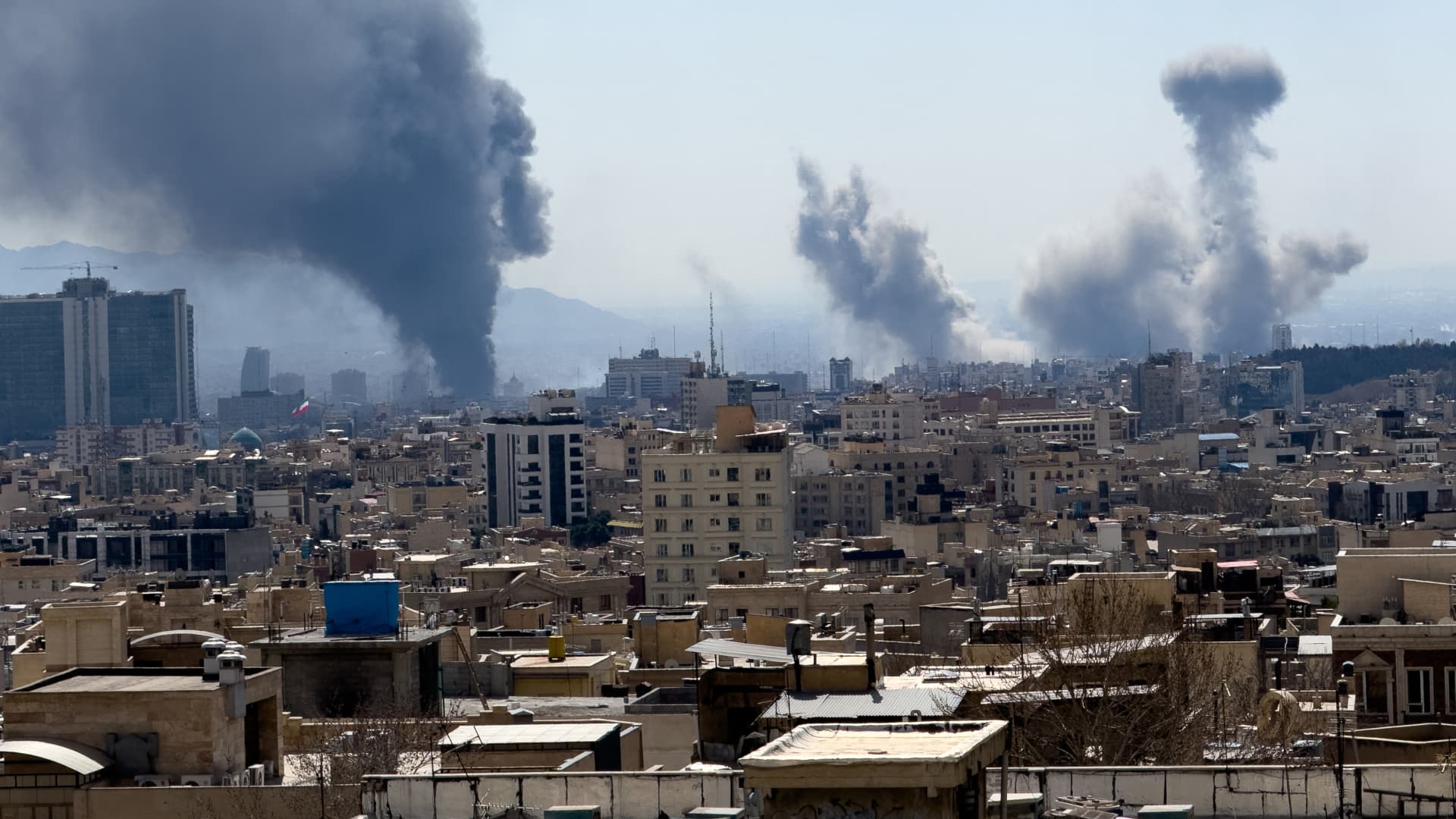
Plumes of smoke rise over the residential areas of the Iranian capital following airstrikes amid ongoing U.S.â”Israel attacks as multiple explosions are heard across the city in Tehran, Iran on March 01, 2026.
Anadolu | Anadolu | Getty Images
Investors are bracing for risk-off trades once markets reopen after the weekend, as the conflict in the Middle East widens.
Gains are expected in so-called safe-haven assets like the U.S. dollar and gold, while equities could pull back.
Oil market participants have been closely watching the conflict, which risks a major oil supply shock in the Middle East.
Markets could swing between risk-on relief — if regime collapse removes the threat of oil blockades or nuclear escalation — and risk-off persistence if conflict drags on and supply disruptions intensify, according to Ben Emons of FedWatch Advisors.
Airlines have canceled hundreds of flights, while dozens of others were rerouted mid-flight due to closed airspace over a large swath of the Middle East. Airspace closures also forced carriers to scrub flights that would normally transit the region.
Read the full story here.
—Anniek Bao
Iran’s internet has been down for more than 24 hours, monitoring organization says
Iran’s internet been down for more than 24 hours, an online traffic monitoring organization said Sunday.
“The measure limits civic engagement at a key moment for the country’s future after the killing of Ayatollah Khamenei in US and Israeli airstrikes,” NetBlocks said in a post on X.
Network connectivity in Iran from Feb. 24, 2026 to March 1, 2026. NetBlocks.org.
NetBlocks.org
Israel says it has carried out more strikes in Tehran
Smoke rises from the area after it was targeted in attacks as a series of explosions are heard in Tehran, Iran on March 01, 2026.
Fatemeh Bahrami | Anadolu | Getty Images
Israel said Sunday it has carried out more strikes against Iran’s government in the capital.
“The Air Force, guided by Military Intelligence, has now launched a broad wave of strikes toward targets of the Iranian terror regime in the heart of Tehran,” the Israel Defense Forces said in a post on X.
“Over the past day, the Air Force conducted extensive strikes to achieve air superiority and open the path to Tehran,” the IDF said.
—Azhar Sukri
Investors reassess risk after Khamenei strike, with oil in spotlight
An Iranian man holds up a portrait of Iran’s Supreme Leader Ayatollah Ali Khamenei during a rally in Tehran, Iran, on March 1, 2026, following the confirmation of Ayatollah Khamenei’s death by state TV.
Nurphoto | Nurphoto | Getty Images
Iran woke up Sunday to a once-in-a-generation shock: state media confirmed Supreme Leader Ayatollah Ali Khamenei was killed in a joint U.S.–Israel strike.
For markets, the key question is what comes next.
Standard Chartered’s Global Head of Research, Eric Robertsen, said in a note that investors had already been underpricing geopolitical risk. The U.S. dollar is only modestly weaker year-to-date, but the dispersion beneath the surface is telling: commodity-linked currencies are outperforming, suggesting markets are paying for exposure to scarce resources and terms-of-trade winners.
Ben Emons of FedWatch Advisors adds a high-volatility geopolitical lens. Leadership strikes in Tehran raise regime-change tail risks and leave an uncertain endgame. Markets could swing between risk-on relief — if regime collapse removes the threat of oil blockades or nuclear escalation — and risk-off persistence if conflict drags on and supply disruptions intensify.
The immediate pressure point may be energy. A sustained surge in crude prices would quickly ripple through inflation expectations and hit Asia’s oil-importing economies hardest, analysts say.
As trading resumes, investors will be watching oil prices and the U.S. dollar versus Asian currencies for the first real signal of how seriously this shock is being priced in.
—Spriha Srivastava
Middle East markets lower on Sunday as regional tensions rise
Markets in the Middle East opened lower on Sunday due to regional tensions.
Shares in Muscat opened lower as investors withdrew funds, indicating market fear that the weekend’s events would turn into a protracted conflict after Israel and the U.S. attacked Iran, and the Islamic Republic retaliated across Arab and Gulf cities.
Muscat’s main index, the .MSX30, tumbled more than 3% in Sunday trade. The country was not targeted by the Islamic Republic as it played a key mediation role in talks between the U.S. and Iran in recent weeks. Oman’s foreign minister took to X to express his “dismay” at the joint strikes on Iran by the U.S. and Israel, saying “active and serious negotiations have yet again been undermined.”
Kuwait’s stock exchange implemented a trading suspension until further notice. Kuwait was hit by Iranian missiles, as was Amman, Doha and Riyadh, which remained open on Sunday.
Saud Arabia’s Tadawul was down nearly 1.5%, while Qatar’s main benchmark traded down nearly 2%. Amman’s bourse was also down 2%, while Bahrain’s exchange hovered around 0.88% lower.
The United Arab Emirates has been subjected to a second day of explosions, heard by CNBC’s team on the ground in the country. Dubai and Abu Dhabi’s exchanges open for trade on Monday morning; they closed lower in Friday’s trade.
Israel’s Tel Aviv stock exchange opens Monday morning for trading, and the exchange shifted in January to Monday-Friday trading in line with global markets.
—Emma Graham
Iran’s Larijani says U.S., Israel seek to ‘plunder and disintegrate Iran’: State TV
Iran’s security chief Ali Larijani attends a ceremony by the Lebanese Shiite movement Hezbollah marking the first anniversary of Israel’s assassination of their longtime leader Hassan Nasrallah, in Beirut’s southern suburbs on September 27, 2025.
Anwar Amro | Afp | Getty Images
Iran’s top security official, Ali Larijani, said the United States and Israel are seeking to “plunder and disintegrate” the country, Reuters reported, citing state television, as Tehran moves to shore up control following the killing of Supreme Leader Ayatollah Ali Khamenei.
Larijani said a temporary leadership council would be established on Sunday and warned that any “secessionist groups” attempting to take action would face a harsh response.
—Lee Ying Shan
UAE announces remote learning for schools, universities from Monday as Iran targets Gulf states
A plume of smoke rises from the port of Jebel Ali following a reported Iranian strike in Dubai on March 1, 2026.
Fadel Senna | Afp | Getty Images
The United Arab Emirates has ordered schools and universities nationwide to switch to remote learning from Monday to Wednesday as Iran launches attacks on Arab states with U.S. assets.
In a post on X Sunday, the UAE’s Ministry of Education and the Ministry of Higher Education and Scientific Research said that students, educational and administrative staff in all public and private schools nationwide will switch to “distance learning” for the upcoming three days.
— Anniek Bao
Trump warns Iran against retaliation, vows using force ‘never been seen before’
U.S. President Donald Trump speaks to the media after arriving in Corpus Christi, Texas, U.S., Feb. 27, 2026.
Elizabeth Frantz | Reuters
U.S. President Donald Trump warned Sunday that Washington would respond with unprecedented force if Iran retaliates against recent U.S. strikes.
In a post on Truth Social, Trump wrote: “Iran just stated that they are going to hit very hard today, harder than they have ever been hit before,” adding, “THEY BETTER NOT DO THAT, HOWEVER, BECAUSE IF THEY DO, WE WILL HIT THEM WITH A FORCE THAT HAS NEVER BEEN SEEN BEFORE!”
—Lee Ying Shan
Waves of loud blasts reported in Doha for second day: media reports
Motorists drive past a plume of smoke rising from a reported Iranian strike in the industrial district of Doha on March 1, 2026.
– | Afp | Getty Images
Several loud explosions were heard in the Qatari capital Doha for a second day on Sunday, according to media reports.
Reuters reported blasts were heard in the Dubai area as well as Doha. In a video posted by Doha News on Sunday, thick smoke was seen billowing near Barwa in Doha after Iran launched missiles towards Qatar that hosts U.S. military bases.
— Anniek Bao
Iran after Khamenei: What’s next and what it means for the world?
People mourn the death of Iran’s supreme leader Ayatollah Ali Khamenei, who was killed in joint US and Israeli strikes, in Tehran on March 1, 2026. A
Atta Kenare | Afp | Getty Images
The death of Iran’s Supreme Leader Ayatollah Ali Khamenei sets in motion a formal succession process that could have significant implications for the country’s political stability, sanctions outlook and already strained economy.
However, analysts warned that elimination of the supreme leader does not equal transformation.
“Taking out Iranian Supreme Leader Ayatollah Ali Khamenei is not the same as regime change. The Islamic Revolutionary Guard Corps is the regime,” the Council on Foreign Relations noted following his passing, limiting the prospects for immediate political or economic transformation.
Marko Papic, chief strategist at Clocktower Group, echoed a similar views: “The Iranian economy is soon to be a parking lot unless the next Supreme Leader is more amenable to negotiating with the U.S.”
Read the full story here.
— Lee Ying Shan
Airports in Gulf states, hotel damaged as Iran retaliates against U.S.-Israeli strikes
An Emirates Boeing 777 stands at the gate at Dubai International Airport as another prepares to land on the runway in Dubai, United Arab Emirates, Aug. 17, 2022.
Jon Gambrell | AP
Airports in Dubai and Abu Dhabi were damaged overnight as Iranian retaliatory attacks spread across the Gulf states.
“An incident” at Dubai International Airport left four staff injured, according to a social media post by the emirate’s media office.
Most airport terminals had been cleared of passengers, the authority said, adding that further updates will be provided as they become available.
Authorities in Abu Dhabi also reported an interception of a drone that targeted the Zayed International airport, killing an Asian national and leaving seven injured.
Iran has responded to the U.S.-Israel strikes by targeting Israel and multiple Gulf states, including the UAE, Qatar, Bahrain, Saudi Arabia, Kuwait, and Jordan, which host U.S. assets.
An intercepted Iranian drone reportedly caused a minor fire on the Burj Al Arab’s outer facade.
One of the berths at Dubai’s Jebel Ali Port also caught fire due to debris resulting from an aerial interception, according to local media reports, citing Dubai authorities.
—Anniek Bao
Iran hit by near-total internet blackout as conflict intensifies
Plumes of smoke rise following reported explosions in Tehran on March 1, 2026.
Atta Kenare | Afp | Getty Images
Iran experienced a near-total internet shutdown starting around 2 a.m. ET Saturday, according to independent internet monitoring group NetBlocks.
The organization, which uses network measurement and web traffic analytics to detect government-imposed outages, reported that national connectivity fell to just 4% of normal levels.
Posting on X, NetBlocks said the disruption coincided with U.S. and Israeli military operations and resembled restrictions imposed during last year’s conflict with Israel.
—Lee Ying Shan
Islamic Revolutionary Guards Corps chief dies in U.S.-Israeli attack: Reports
Commander-in-chief of the Islamic Revolutionary Guards Corps died in the U.S.-Israeli attack against Tehran on Saturday, the country’s official news agency reported. Ali Shamkhani, representative of the Supreme Leader in the Supreme Defense Council, was also killed.
File: Secretary of the Supreme National Security Council of Iran Ali Shamkhani makes a speech during the Regional Security Dialogue Meeting in Tehran, Iran on September 26, 2018.
Fatemeh Bahrami | Anadolu | Getty Images
“We are hearing that many of their IRGC, Military, and other Security and Police Forces no longer want to fight and are looking for Immunity from us,” Trump said in the aftermath of Iranian Supreme Leader Ayatollah Ali Khamenei’s death.
— Vinay Dwivedi
