


Over the last year, the nonprofit sector, from individual organizations to funders, has experienced uncertainty from multiple angles. That includes significant changes to public funding and philanthropy and a more competitive environment, while also leading their organizations and teams through a time of rising operating costs and economic uncertainty.
During our first Power Breakfast of 2026, held Feb. 12 at the Krause Gateway Center, panelists covered the ways funding pressures are adapting their operations and strategies, the increased need for nonprofits to demonstrate their value and the need for ongoing cross-sector collaboration to fulfill community needs and priorities.
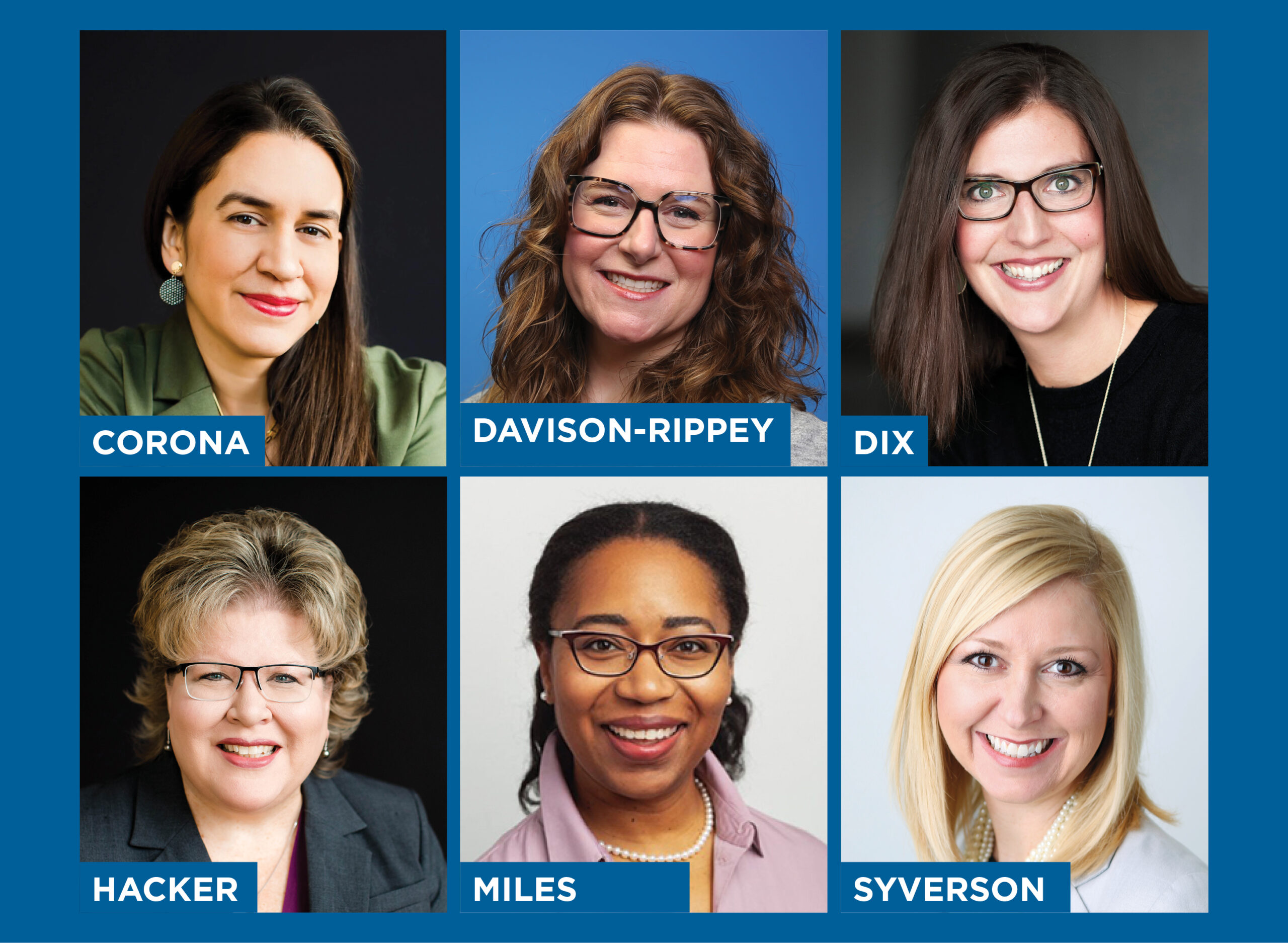
Panelists included:
- Maria Corona, executive director, Iowa Coalition Against Domestic Violence
- Erin Davison-Rippey, senior community impact officer, United Way of Central Iowa
- Sally Dix, president, Bravo Greater Des Moines
- Annette Hacker, chief communications and strategy officer, Food Bank of Iowa
- Jo Christine-Miles, director, Principal Foundation and Principal Community Relations
- Nikki Syverson, principal, Isaacson-Syverson Consulting
Here are our reporters’ takeaways from the event.
Justifying existence
Dix pointed out that nonprofit is a tax status not a business model. All of the challenges nonprofits currently face are the same ones faced by small businesses including insurance rate hikes, increased costs of goods and difficulty finding employees, she said. The big difference between the two is that nonprofits face the additional hurdle “of needing to justify [their] existence,” Dix said. “It seems like the pressure to demonstrate your value and the need to play a little more defense than offense. That takes away from your ability to be looking forward.”
— Kathy A. Bolten
Principal Foundation adjusts grant strategy
Principal Foundation was created in 1987 from an endowment from Principal Financial Group. The foundation provides grants to a wide array of causes, from housing to disaster relief support and food banks to financial education. The grants are funded from returns on investments from the endowed funds. An uncertain economy, “impacts what we can give and how we can give,” Miles said. “The way we’ve reacted to that in 2026 is to restrict our grant portfolio to the 90 entities already in the portfolio and extending multi-year grants to ensure that they remain stable and that they remain confident that at least Principal Foundation will be with them through this particular storm.”
— Kathy A. Bolten
Young generations and the arts
As baby boomers age — and die — an estimated $84 trillion is expected to have been passed to younger generations and charitable organizations. Miles cautioned that current research shows that younger generations don’t have the same affinity for the arts as baby boomers. “That’s a scary thought if the next generation receives that wealth transfer and refuses to invest some of it in the art sector,” she said. “Why is that scary? We know that where you have rich cultural and civic fabric in a community, you have better community development, better economic development and better life outcomes. … The idea of the [arts] being defunded is terrifying.”
— Kathy A. Bolten
Increased collaboration across communities to address big issues
Davison-Rippey said with human services nonprofits working to meet a rising demand for basic needs in the community, leaders from across sectors need to continue to come together and think at a systems level.
“Take, for instance, food insecurity. Our community came together a couple of years ago to really think about food insecurity at a community level. How can we all work collaboratively? Nonprofit, business, public sector, how do we work cross-collaboratively to address these big, systemic issues, ensuring that we’re leaning into the strengths of individual entities and working together to solve these issues? Homelessness is another issue where the community has come together and created a strategic plan, the Blueprint to Address Homelessness, to really think about these issues on a systems level, thinking about root causes, thinking about how we all work together to solve these big issues.”
No one has the wiggle room anymore to duplicate efforts, she said.
“We all are really driven to figure out how we work most effectively together and come together as a community,” she said. “I suspect that that would be a direction that our community continues to move in.”
— Lisa Rossi
Meeting higher need amid lower support and disruption
“We’ve been dealing with rising and record need for nearly four years now,” she said. “At times, certainly at the tail end of last year, it seems overwhelming, but we have to be there for Iowans who are facing food insecurity. We can never fill the gap that SNAP fills, because for every meal the charitable food system provides, SNAP provides nine. It is the most effective anti-hunger relief program in history. So a strong SNAP program, a strong Farm Bill would be a help as well.”
The bottom line is, she said, more people in Iowa need help with food than ever before.
“Food costs more and it costs more to get it here. That’s where the fundraising is so critically needed,” she said. “We’ve had to get more and more creative with our fundraising, finding sponsors for school pantries, finding … organizations who want to sponsor their volunteer shift. All of those things are helping us to meet the need. But in all this uncertainty, the one thing that is for sure is that the numbers of people who need help with food are not getting smaller, they’re only getting larger.”
— Lisa Rossi
Central Iowa’s flat outlook on giving
Isaacson-Syverson Consulting’s recently released State of Central Iowa Philanthropic Giving report shows about half of donors expect their giving to stay flat in 2026.
“For individuals, 52% think that their philanthropic giving will stay the same. For corporations and foundations, 56% think it’ll stay the same. Not a lot said they would decrease, which we did see two years ago. But what does that mean? That means that every single one of you nonprofits in this room, you have increased costs and you have an increased goal, and your board is saying, raise more dollars, right?”
Syverson said the data point is a sign that nonprofits need to look for additional donors.
— Lisa Rossi
Competition for dollars
Dix said the community is asking for collaboration, but at the same time, there is competition over which nonprofits receive funding, which in turn influences which issues are viewed as important.
“There’s $1 and one of you is going to get it, and I think there’s a lot of difficulty there,” Dix said. “One of the challenges … is that donors are making decisions for the entire community about what is essential, and I think that creates stratification within the nonprofit sector about which are the important ones, and which are the ones that should be valued.”
She said that individual donors, as well as organizations like Bravo, a regional community-based funder, need to make sure they are not overstepping and “making decisions about what is essential for everyone.”
“I truly believe that every nonprofit exists for a reason and is providing services that are valued by someone,” she said. “And I just get a little uncomfortable when we get into conversations about what is the most important, or what [are] the essential services, because I’m not sure those are decisions we as individual donors or individual nonprofit representatives get to make for an entire community.”
— Lisa Rossi
Hacker on collaboration among nonprofits
“We’ve also seen nonprofits step up for one another in terms of collaboration,” she said. “I think about Chuck Current at Meals from the Heartland, who last summer, when we were truly overwhelmed trying to execute Healthy Kids Iowa, [the state’s pilot summer food program for children] and so were 125 of our partners, he said, ‘Hey, we’ve got a truck and a driver. We can help you one day a week, and we have a fleet of trucks.’ But that one truck and that one driver helped us out tremendously, and he didn’t have to do that. He picked up the phone and offered. That’s the spirit of collaboration that we have in this community. … When hard things happen, not only does the community rise to the occasion, but we rise to the occasion for one another.”
— Lisa Rossi
Miles on funders expanding their toolkit to help more nonprofits survive
“I’d like to pick up on this idea of collaboration and what is a merger,” she said. “What you’re talking about in this sector right now are distressed mergers. [Principal] is a funder that endeavors to use more of the tools in its funder tool kit, and out of our 90 grantee portfolio, we have four of them at risk of going under. Rather than seeing something that was valuable and funders saying what’s important and what isn’t, we ask them to be creative around what they do to ensure survival.”
Miles said even if it isn’t a service provided in Des Moines or a service “I can quantify as important,” someone was using it because it maybe existed 20 or 30 years ago. One example she gave was a nonprofit that provided financial services and business planning for creatives that was based in Brooklyn, N.Y., that couldn’t make it.
“Where is it now? It’s a nonprofit with a fantastic history and staff in Minneapolis,” she said. “So it moved across the country. It’s with a completely different set of folks but they still serve that same population.”
And instead of making the new entity through the funding process, “we committed to having the funding follow them,” Miles said.
— Michael Crumb
Corona on impact of funding cuts on nonprofits
Corona said in Iowa, her organization has not received an increase in funding, which is hurting their ability to serve clients “who are in very dramatic circumstances.”
“Our model is a 24/7 response model, which means a victim advocate is there to support a survivor at a hospital when they were sexually assaulted. They’re there to support a survivor when they want to pursue a protection order and navigate the court system.”
Stagnant funding creates a workforce problem, Corona said.
“We cannot retain people [and] we have a high demand of services post-COVID, and as an organization that depends on federal dollars to do this hard work, we are seeing significant changes in this administration’s policies that are adding barriers to the work we do on the ground.”
— Michael Crumb
