


Free Newsletter
Get the hottest Fintech Singapore News once a month in your Inbox
The payment industry is undergoing a profound transformation, driven by growing demand for seamless, contactless, and autonomous experiences, alongside an accelerating rollout of artificial intelligence (AI) and machine learning (ML) throughout the payment value chain.
In the Asia‑Pacific (APAC) region, consumer adoption of AI‑driven shopping tools is soaring, laying fertile ground for agentic payments that act on behalf of buyers. Yet, a new Visa survey reveals that lingering concerns about security and transparency are creating hesitation at the moment of checkout.
The survey, which polled more than 14,700 consumers across 14 APAC markets in 2025, found that 74% of respondents are already using AI to shop, leveraging the technology to discover, track or learn about products. This underscores a strong appetite for AI during the early stages of the purchase journey.
Singaporeans are among the top adopters of AI, with eight in ten local consumers now relying on the technology for assistance when shopping online.
Trust gaps and transparency concerns
While many consumers in APAC are comfortable using AI to compare prices and better understand product features, confidence fades when it comes to handling money and personal data. 32% of APAC consumers are reluctant to share personal or payment information with AI systems, drawing a clear line between using AI to browse and trusting the same technology when transactions become more personal.
Additionally, 26% are unsure if AI recommendations fully align with their best interest, signaling some level of suspicion and a demand for greater transparency and user control.
Nearly half (45%) of those surveyed in APAC indicated that they would be more open to AI-powered or agentic commerce if they had stronger assurances around payment security. This highlights the pivotal role that trust and clear data‑usage policies will play in scaling AI‑driven commerce.
The study also revealed income and regional variations. In particular, affluent households with monthly income of US$8,000 or above exhibited the most caution, with 39% of this group demanding higher expectations around how their data is used, compared to 29% for lower-income groups. Digital-first markets such as Australia (38%), New Zealand (37%) and Singapore (34%) also displayed above-average caution, suggesting that consumers in digitally advanced economies tend to be more vigilant about privacy and are likely to demand stricter safeguards compared with other markets.
Emerging markets most open to agentic commerce
Within APAC, the study shows that emerging economies are the most open to fully autonomous AI commerce. India and Vietnam lead the region in this regard, with 42% of consumers in each market being prepared to use AI for online purchases, indicating strong appetites to experiment with new ways of shopping.
In contrast, consumers in digitally mature economies show greater reservation towards AI-enabled online shopping, with just 14% in Singapore, 14% in Japan and 16% in New Zealand expressing interest. This could indicate higher concerns about control or privacy for agentic commerce.
Agentic commerce refers to the use of autonomous AI agents that can act on behalf of customers or businesses throughout the buying journey. These AI agents can find, compare, and potentially make purchases for customers based on their needs and preferences, aiming to enhance customer experience, convenience, and efficiency.
Agentic commerce represents a booming industry that’s set to influence over US$1 trillion in e-commerce spending. According to research by Boston Consulting Group (BCG), 81% of US consumers expect to use agentic AI tools to shop, shaping more than half of all online purchases in the near future.
Powering agentic payments
Within this space, a new class of startups and solutions is emerging to support agentic commerce. These solutions allow organizations to build and deploy AI agents that learn, adapt, and make real-time decisions across the entire payments value chain.
Stripe, for example, launched in September 2025 an API for agentic payments. It also introduced with OpenAI the Agentic Commerce Protocol, which is designed to enable AI agents to complete purchases on behalf of users.
Similarly, Visa has created Visa Intelligent Commerce, offering a suite of tools and protections to support agentic commerce and enable AI-driven purchases through Visa’s payment network. These tools include tokenized “AI-ready” payment credentials, APIs for authentication, transaction controls, and lifecycle management, personalization and consent-driven data sharing, as well as fraud preventions and security features.
Earlier this week, Singapore’s DBS Bank became the first bank in APAC to pilot Visa Intelligent Commerce for agentic transactions. This collaboration will allow the two organizations to example a broad range of use cases, including online shopping, travel bookings and more, aiming to make digital transactions more seamless for consumers, reduce manual steps and streamline payment processes.
In e-commerce, agentic payments are poised to address several high-impact use cases. According to an extensive post by AWS, AI agents can choose the best route for a payment by considering fees, regulations, currencies, and fraud risks. They can also manage foreign currency flows and liquidity so companies always have the right funds in the right places. In cross-border payments, AI agents can monitor currency markets and execute exchanges at better times to reduce costs.
These systems also improve security by detecting fraud through multiple specialized agents working together. They can fix failed payments automatically by understanding payment network rules and local regulations. In e-commerce, AI assistants may eventually search for products and complete purchases on behalf of users.
Finally, AI agents can automate operational tasks such as matching invoices with payments and handling payment disputes, reducing manual work and speeding up resolution.
The rise of AI agents
Beyond commerce, AI agents are gaining traction across an array of business applications and industries. Since 2023, more than 500 AI agent startups have emerged across over 20 categories, including financial services, supply chain, and healthcare.
Booming funding activity has further helped propelled this market. In 2024, AI agent startups raised US$3.8 billion, nearly tripling 2023’s total.
Adoption is also keeping pace. A 2025 McKinsey survey of nearly 2,000 professionals in 105 nations found that 23% of respondents said their organizations were scaling an agentic AI system somewhere in their enterprises, and an additional 39% were experimenting with AI agents. But use of agents is not yet widespread, with most of those who are scaling agents stating that they were only doing so in one or two functions.
Phase of AI agent use at respondents’ organizations, by business function, % of respondents, Source: McKinsey, 2025
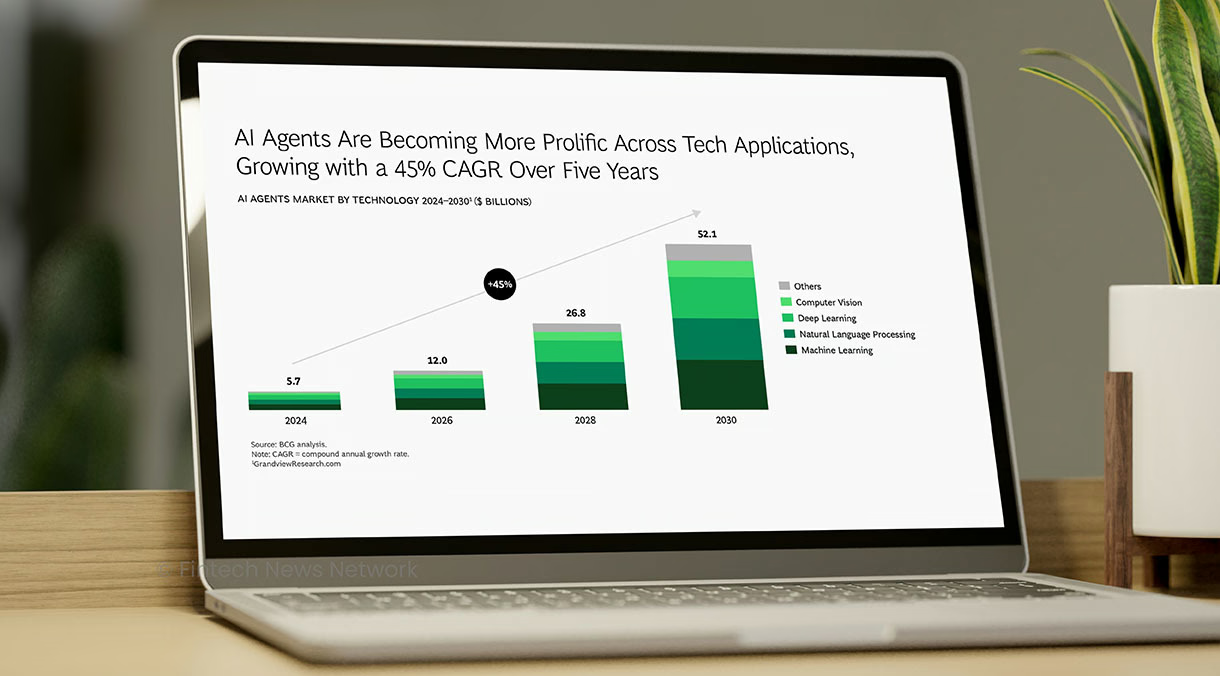
Despite the early-stage nature of implementation, the market for AI agents is expected to grow strongly over the coming years. BCG projects an annual growth rate of 45% through 2030, with the the AI agent market surging from US$5.7 billion in 2024 to US$52.1 billion in 2030.
AI agents market by technology 2024-2030 (US$ billion), Source: BCG analysis
Featured image: Edited by Fintech News Singapore, based on image by thanyakij-12 via Freepik
